
Spotting the gap between what was agreed and what happens and closing it before it becomes a habit.
Most leaders know what good looks like. The harder part is what happens when what you see doesn’t match what was agreed.
- A process isn’t followed.
- An action doesn’t get completed.
- A standard starts to slip.
- A conversation happens — but nothing really changes afterwards.
It can be tempting to let small things go. Perhaps you don’t want to make a big issue out of something. Perhaps the person is usually brilliant. Perhaps you’re busy. Or perhaps having the conversation simply feels uncomfortable.
But what we repeatedly walk past can quickly become what we accept.
Holding others to account isn’t about catching people out or looking for mistakes. It is about making sure that the standards we agree together actually mean something.
When there is a gap between what we said would happen and what actually happens, good leaders notice it, explore why it happened and help close that gap.
Fairly. Directly. Promptly.
A Setting That Gets This Right Will…
- Have leaders who model the same accountability they expect from others
- Address small performance gaps before they become established habits
- Have clear expectations that people understand and follow
- Create a culture where feedback and challenge feel normal rather than personal
- Deal with issues fairly and consistently across the team
- Follow up agreed actions rather than repeatedly having the same conversations
- Support people to improve when they need help
- Protect high standards for children even when conversations feel uncomfortable
Spot the Gap
Accountability starts with something very simple: What did we agree? and What actually happened?
The difference between the two is the gap.
For example:
- Agreed: Room checks will be completed before children arrive.
Reality: They are regularly being completed once the session has started. - Agreed: A practitioner will improve the quality of observations following feedback.
Reality: Three weeks later, the same issues remain. - Agreed: A Room Leader will brief their team following the leadership meeting.
Reality: Their team don’t know about the changes discussed.
None of these automatically mean somebody is a poor performer.
But they do deserve our attention.
Start With Facts
Before addressing an issue, make sure you understand:
- What was expected?
- Was the expectation clear?
- What actually happened?
- What evidence do you have?
- Has this happened before?
Accountability is strongest when it is based on what happened, rather than assumptions about someone’s attitude or intentions.
Instead of: “You don’t seem to care about this.”
Focus on: “We agreed this would be completed by Friday, and it hasn’t been completed.”
That gives you something concrete to discuss.
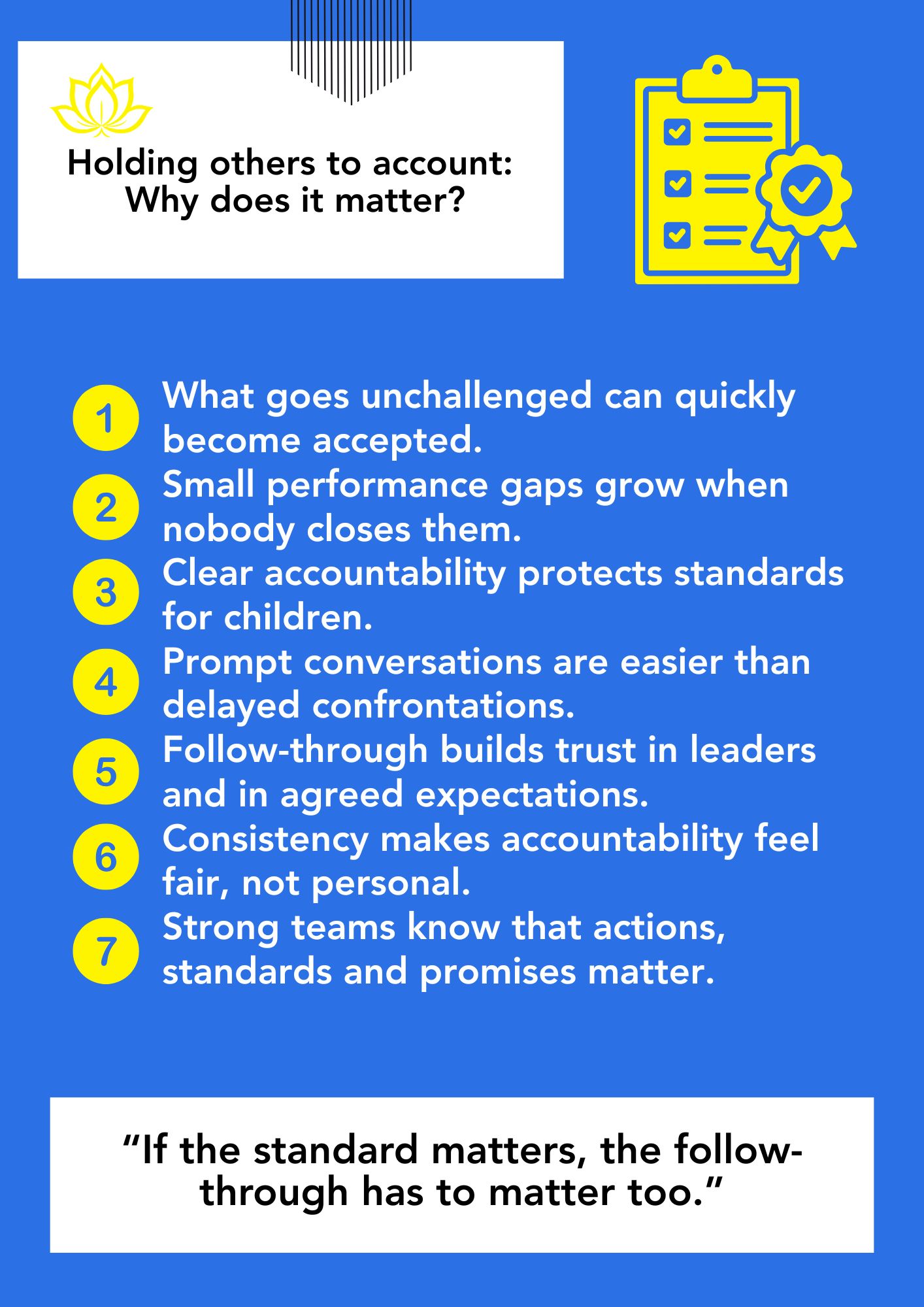
Why does it matter?
Don’t Let Small Gaps Become Normal
Not every mistake needs a formal conversation because people forget things, people misunderstand and people have difficult days.
Good leadership allows room for people to be human.
But there is a difference between a one-off slip and something that is beginning to become a pattern.
Ask yourself:
- Has this happened before?
- Have we already discussed it?
- Does it affect children, colleagues or families?
- Could leaving it unaddressed lower the standard?
- Are other people beginning to see this as acceptable?
Small gaps matter because repeated behaviour quickly becomes normal behaviour.
If something matters enough to agree as a team, it should matter enough to follow up.
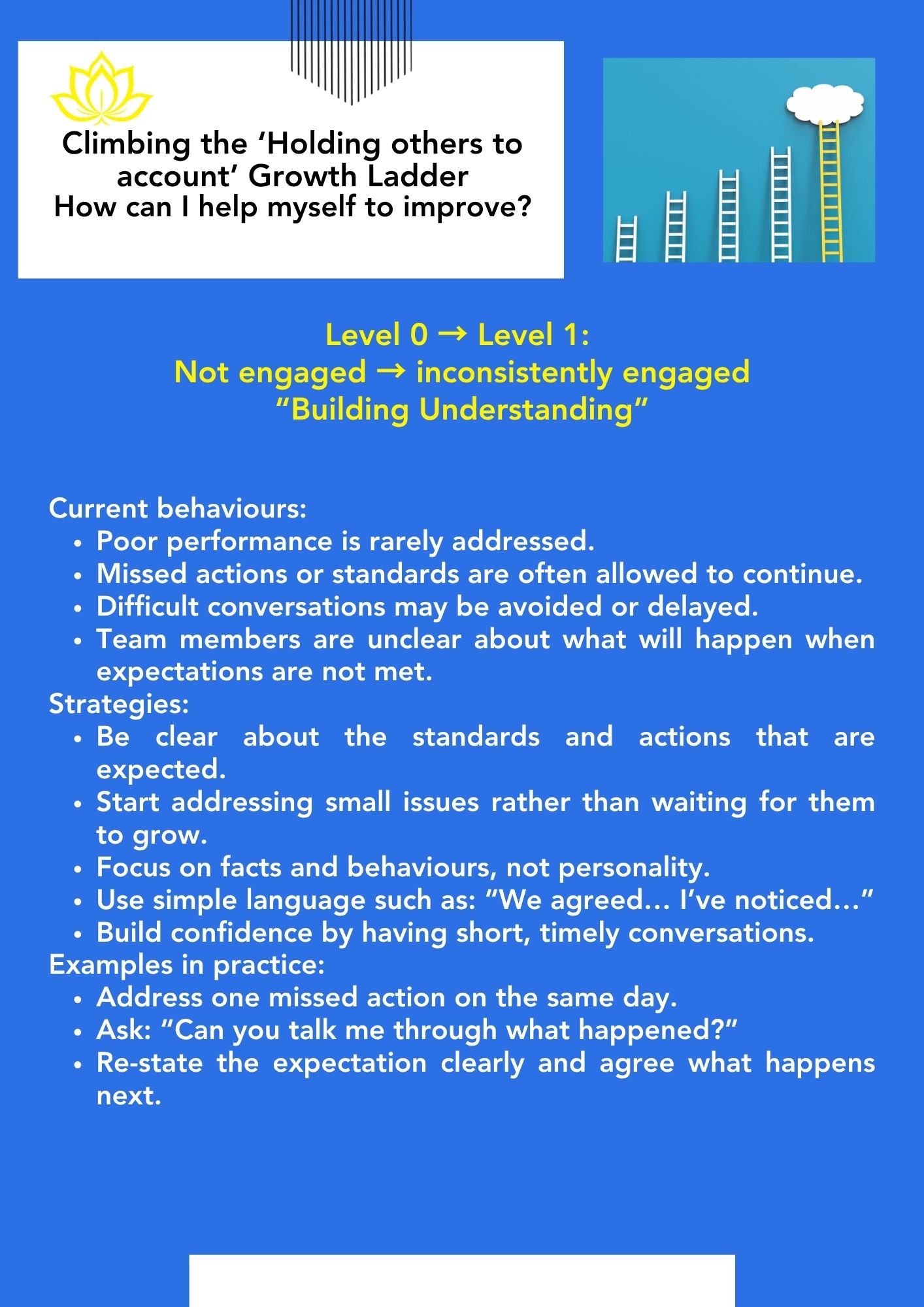
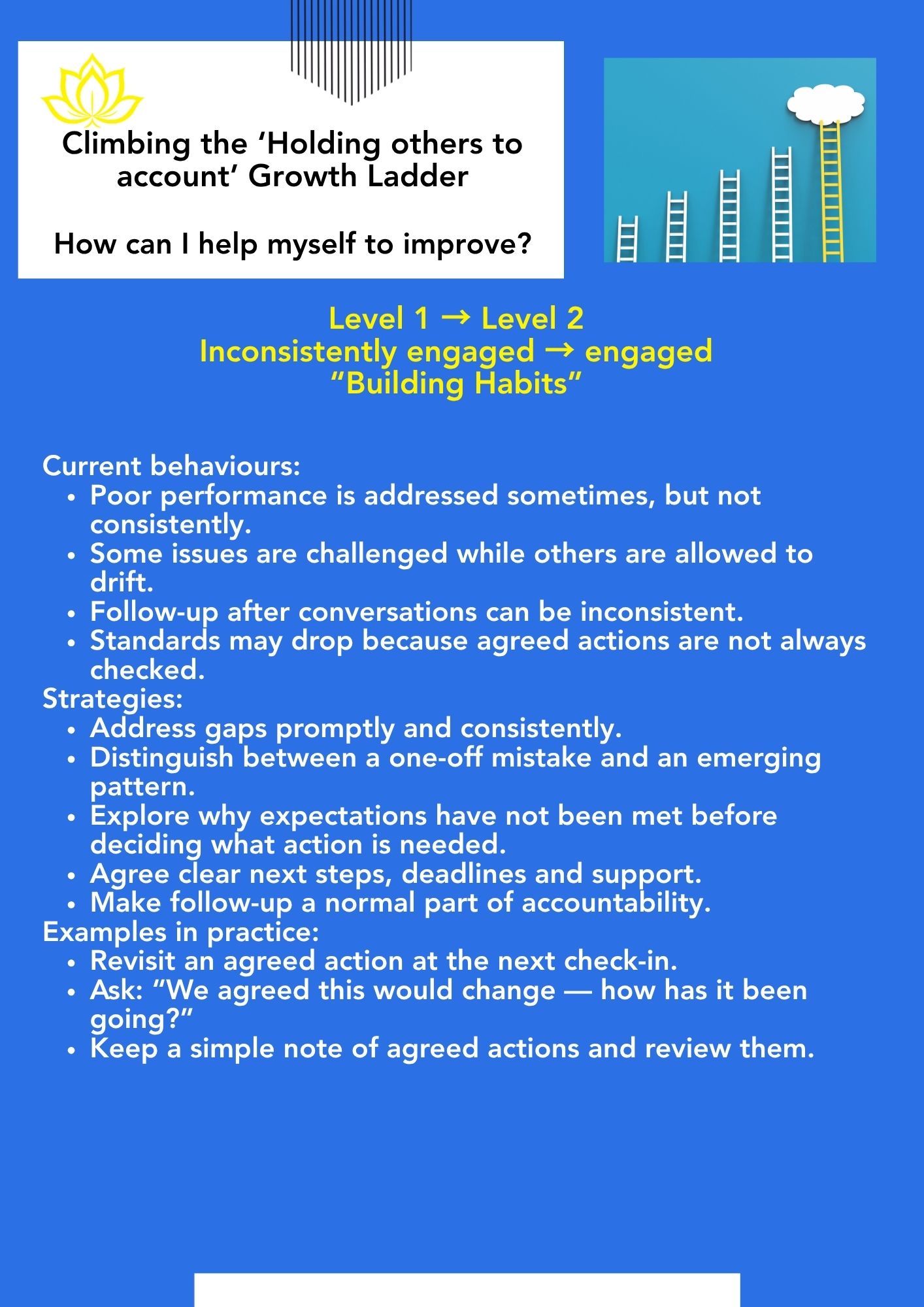
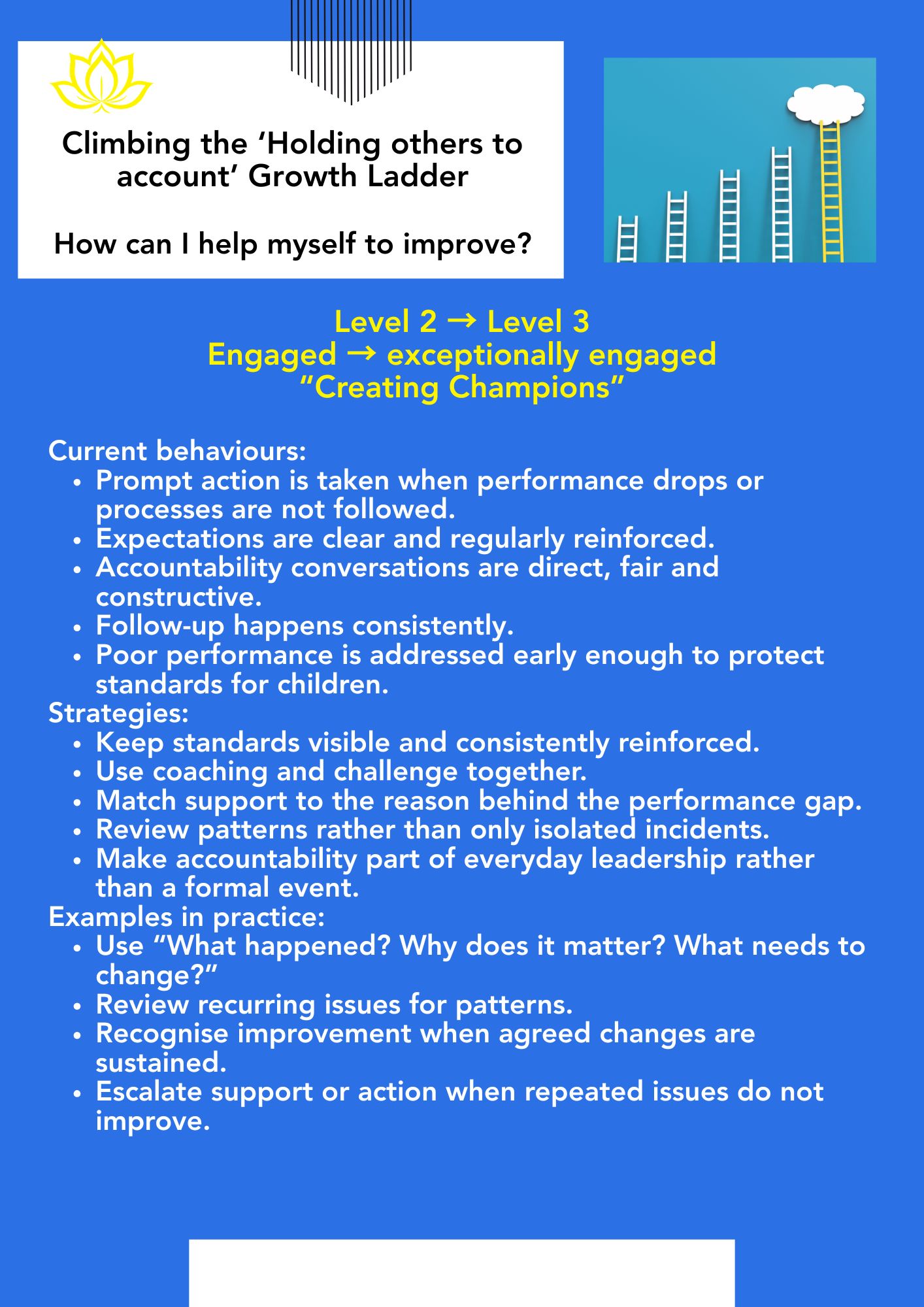
Where are you at right now?
Task One: Reflect and Grow
Consider which statement below best reflects your current position:
| Poor performance is always proactively identified and mitigated against | Prompt action taken to address poor performance and when systems and processes are not followed to ensure high quality support is available for children | Poor performance is not consistently addressed leading to a drop in standards | Poor performance is not addressed |
Now use the insights below to get to the next level…
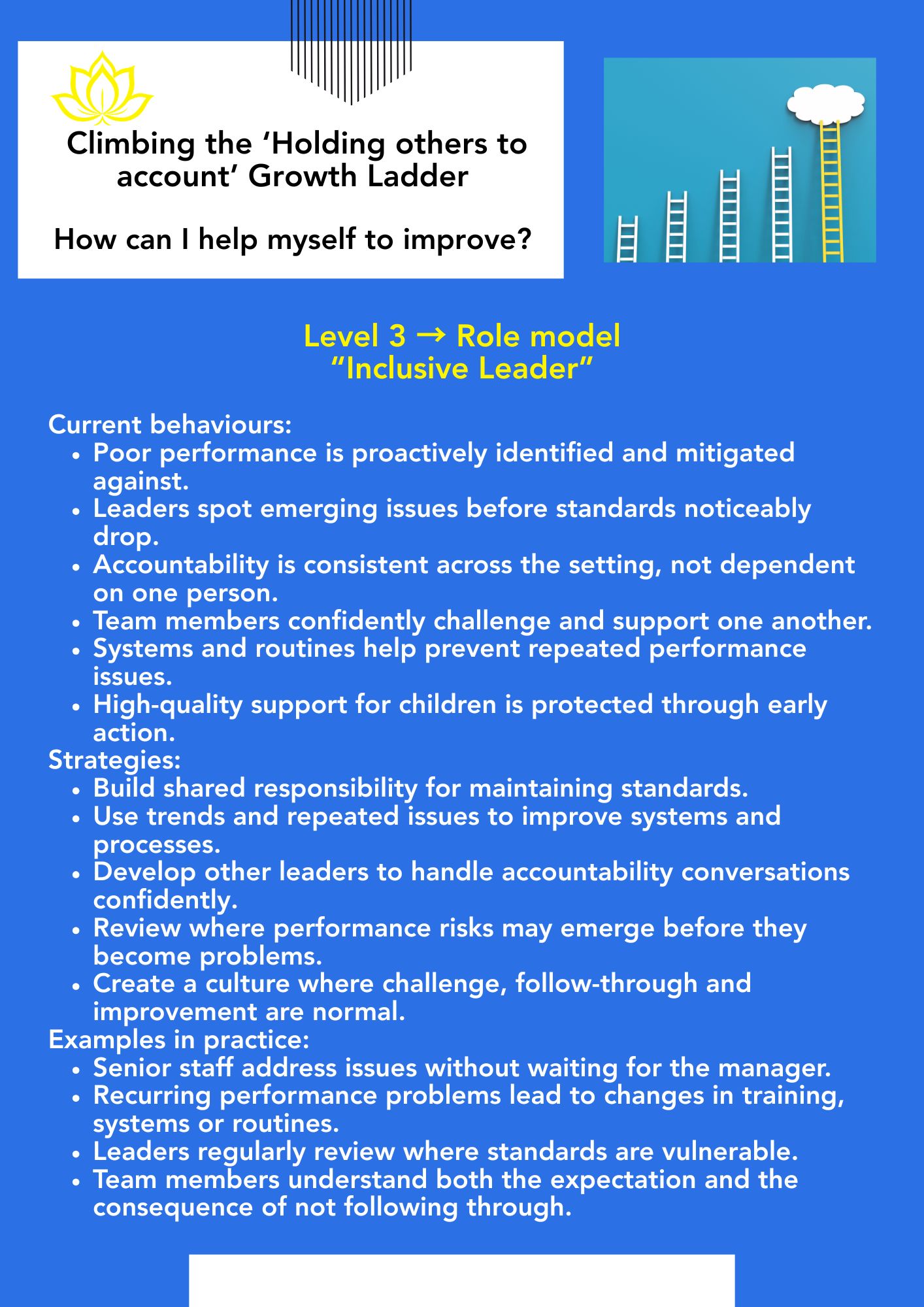
Now you have a better understanding of some headline ideas, let’s go through some important points to keep in mind when holding others to account…
Understand Before You Judge
When someone hasn’t done what was expected, it is easy to jump straight to:
“They didn’t bother.”
But there may be many reasons for the gap.
Perhaps:
- The expectation wasn’t clear
- They didn’t understand why it mattered
- They didn’t know how to do it
- They didn’t have the time or resources
- Other priorities got in the way
- They forgot
- They disagreed with the expectation
- They chose not to follow through
These require different leadership responses.
Someone who doesn’t know how needs support.
Someone who doesn’t understand needs clarity.
Someone who can’t reasonably do it may need a barrier removed.
Someone who repeatedly chooses not to do it, despite knowing what is expected and having the capability to do it, needs accountability.
Ask Before Assuming
A useful starting question is:
“Talk me through what happened.”
Then listen.
Understanding the reason doesn’t mean removing the expectation.
It helps you respond to the right problem.
Have the Conversation Early
One of the easiest leadership mistakes is waiting.
You notice something.
You let it go.
It happens again.
You’re irritated.
It happens again.
Now you’re frustrated.
Eventually you have a much bigger conversation than you needed to have in the first place.
Early conversations are often smaller conversations.
Try: “We agreed X. I’ve noticed Y happened instead. Can you talk me through what happened?”
Then listen.
Once you understand the situation:
“Going forward, I need X to happen because…”
This does three things:
- Makes the gap clear
- Gives the person an opportunity to explain
- Re-establishes the expectation
You don’t need to turn every issue into a major performance conversation.
Sometimes a two-minute conversation today prevents a twenty-minute conversation next month.
Be Clear AND Kind
Holding someone to account can feel uncomfortable because we sometimes confuse being kind with avoiding difficult conversations.
But avoiding an issue isn’t always kind.
If somebody doesn’t know that their performance is falling below the expected standard, they don’t have the opportunity to improve it.
Good accountability combines:
Respect for the person with Clarity about the standard.
You can say: “I know you’re capable of doing this really well, which is why I want to raise it now.”
You can listen to someone’s explanation while still saying:
“I understand that. We still need to make sure this happens going forward.”
Being supportive does not require lowering the expectation.
Being clear does not require being confrontational.
The goal is clarity without unnecessary criticism.
Focus on the Behaviour, Not the Person
Accountability conversations become much harder when they become personal.
Compare: “You’re disorganised.”
with: “The paperwork wasn’t completed by the agreed deadline.”
Or: “You’re not taking leadership seriously.”
with: “We agreed you would brief the team after each leadership meeting, but this hasn’t happened following the last two meetings.”
The second version is:
- Specific
- Observable
- Easier to discuss
- Less likely to make someone defensive
- Clearer about what needs to change
Try to focus on: What happened → Why it matters → What needs to happen next.
Task Two: Close the Conversation Properly
A good conversation doesn’t end with: “Just make sure it doesn’t happen again.”
Both people should leave knowing exactly what happens next. Clarify:
- What needs to change?
- Who is responsible?
- By when?
- What support is needed?
- When will you check back?
For example, after your next conversation with a team member say something like: “So we’ve agreed you’ll complete the room checks before 8.00 each morning. Let’s catch up again next Friday and see how that’s going.”
Now the expectation is clear. So is the follow-up.
Follow Up
This is where accountability often falls apart.
The conversation happens. Actions are agreed. Everyone moves on. Nobody checks again.
If people learn that actions are discussed but rarely revisited, agreements gradually lose their meaning.
Follow-up doesn’t need to feel threatening.
It might simply be: “We spoke about this last week. How has it been going?”
If it has improved, recognise it. “I’ve noticed that’s been happening consistently this week. Thank you.”
If it hasn’t: “We agreed this would change, but I’m still seeing the same issue. We need to understand why.”
Accountability is not one conversation.
It is the combination of clarity + action + follow-through.
Be Consistent
Accountability becomes difficult when standards depend on:
- Who somebody is
- How long they have worked there
- Whether the leader feels confident challenging them
- Whether they are usually a strong performer
- How busy the setting happens to be
Teams notice inconsistency quickly.
If one person is challenged for something while somebody else is allowed to do it repeatedly, accountability starts to feel personal rather than fair.
Consistency doesn’t mean treating everyone identically.
Context matters.
But the standard itself should remain clear.
Ask yourself:
“Would I address this in the same way if another member of the team had done it?”
If the answer is no, consider why.
Accountability Goes Both Ways
Holding others to account is only credible if leaders are willing to be accountable too.
- If you say you will do something: do it.
- If you miss something: acknowledge it.
- If your team challenge you fairly: listen.
Try saying: “You’re right. I said I would have that back to you by Friday and I didn’t. I’ll get it to you today.”
Accountability becomes part of the culture when it isn’t something leaders do to people.
It becomes: How we work together.
- Everyone has responsibilities.
- Everyone can be challenged.
- Everyone follows through.
Task Three: Have a Simple Accountability Conversation
The next time you notice a gap, try this structure:
- What was agreed? “We agreed that…”
- What have you noticed? “I’ve noticed that…”
- Understand why: “Can you talk me through what happened?”
- Re-establish the expectation: “Going forward, I need…”
- Agree the next step: “So we’ve agreed that…”
- Follow up: “Let’s check back on this…”
Simple doesn’t always mean easy.
But having a structure can make an uncomfortable conversation much easier to start.
Everyday Accountability
Accountability should not only appear when somebody is seriously underperforming.
It lives in ordinary moments.
A task wasn’t completed.
A process wasn’t followed.
Someone hasn’t acted on feedback.
An agreed deadline has passed.
A standard isn’t being maintained.
Addressing these things early keeps accountability small, normal and manageable.
Ignoring them often makes the eventual conversation bigger and more uncomfortable.
Task Four: Your Accountability Challenge
Think of one small gap you have noticed recently. Not the biggest performance problem in your setting.
Something everyday. Write down:
- What was agreed?
- What actually happened?
- Why does it matter?
- What do I need to understand?
- What needs to happen next?
Then have the conversation.
Don’t wait for the gap to grow before you close it.
Remember:
What we repeatedly walk past can quickly become what we accept.
Holding someone to account does not mean catching them out.
It means caring enough about the person, the team and the children to address the gap between what we agreed and what is actually happening.
- Notice it.
- Understand it.
- Address it.
- Agree what happens next.
- And follow it through.
That’s how accountability becomes part of everyday leadership rather than a difficult conversation we save until things have gone wrong.
GIST – Good Ideas for Starting Things
- Use “We agreed… I’ve noticed…” the next time something hasn’t been followed through. It keeps the conversation factual and gives you an easy way to start.
- Follow up one existing action this week. Find something previously agreed with a team member and simply ask: “How is that going?”
- Address one small thing sooner. When you notice a gap that matters, try having the conversation that day rather than waiting to see whether it happens again.
- Check your own follow-through. Choose one commitment you’ve made to your team and make sure you complete it too.
Want to Know More?
- Read – Radical Candor by Kim Scott. Particularly useful for understanding how leaders can care personally while challenging directly, rather than choosing between being supportive and being clear. Explore Radical Candor
- Watch – Simon Sinek: We Need Difficult Conversations. A useful reminder that difficult conversations are a necessary part of leadership, trust and growth rather than something effective leaders should avoid. Watch the video.
- Read – Harvard Business Review: Why Accountability Is So Muddled, and How to Un-Muddle It. Explores why clear roles, expectations and accountability matter within organisations. Read the HBR article
- Explore – Radical Candor resources and podcast. Useful practical material on giving feedback that is both clear and human, including how to build trust while addressing performance. Explore the Radical Candor resources