
Creating a culture where children come first, people speak up, and everyone takes responsibility
Safeguarding is not simply something we do. It is the culture we create.
Policies, procedures and training matter, but they only protect children when they are lived out consistently in everyday practice. A strong safeguarding culture is one where people notice, question, speak up, act with integrity and keep children’s welfare at the centre of every decision.
By the end of this course, you should be able to:
- Lead safeguarding expectations through your own behaviour
- Understand what a positive safeguarding culture looks like.
- Create greater psychological safety within your team.
- Promote openness, honesty and professional curiosity.
- Challenge poor practice confidently and appropriately.
- Put children’s welfare at the centre of decisions.
A setting that gets this right will ensure…
- Children’s welfare stays at the centre of decisions.
- Children feel physically and emotionally safe.
- Staff feel psychologically safe to speak up and raise concerns.
- Difficult conversations happen early.
- Everyone understands that safeguarding is their responsibility.
- Leaders are approachable and model expected behaviours.
Safeguarding is a Culture
A safeguarding procedure tells us what we are expected to do. A safeguarding culture determines what actually happens when nobody is reminding us.
Settings can have policies, procedures, training and reporting systems in place and still experience serious safeguarding failures. Why?
Because safeguarding depends on people.
It depends on whether…
- People feel able to speak up.
- Concerns are listened to.
- Leaders challenge poor practice.
- Mistakes are acknowledged or hidden.
And ultimately, it depends on whether the welfare of children is placed ahead of the comfort of adults.
A healthy safeguarding culture includes:
- Everyone speaking up.
- Everyone taking responsibility.
- Mistakes being discussed honestly.
- Concerns being welcomed.
- Children’s voices mattering.
- Leaders modelling the behaviours they expect.
An unhealthy culture can begin to develop when adults’ comfort is placed ahead of children’s safety. “That’s just how we do things” becomes accepted. People become frightened to challenge one another and mistakes lead to blame rather than learning.
People hide or minimise problems and hierarchy stops people raising concerns.
Task One – Reflection
Think about your own room or provision.
What three words would you use to describe the safeguarding culture right now?
Be honest. The purpose is not to judge your team. It is to understand your starting point.
Share these words with your team right now and see what conversations it leads to.
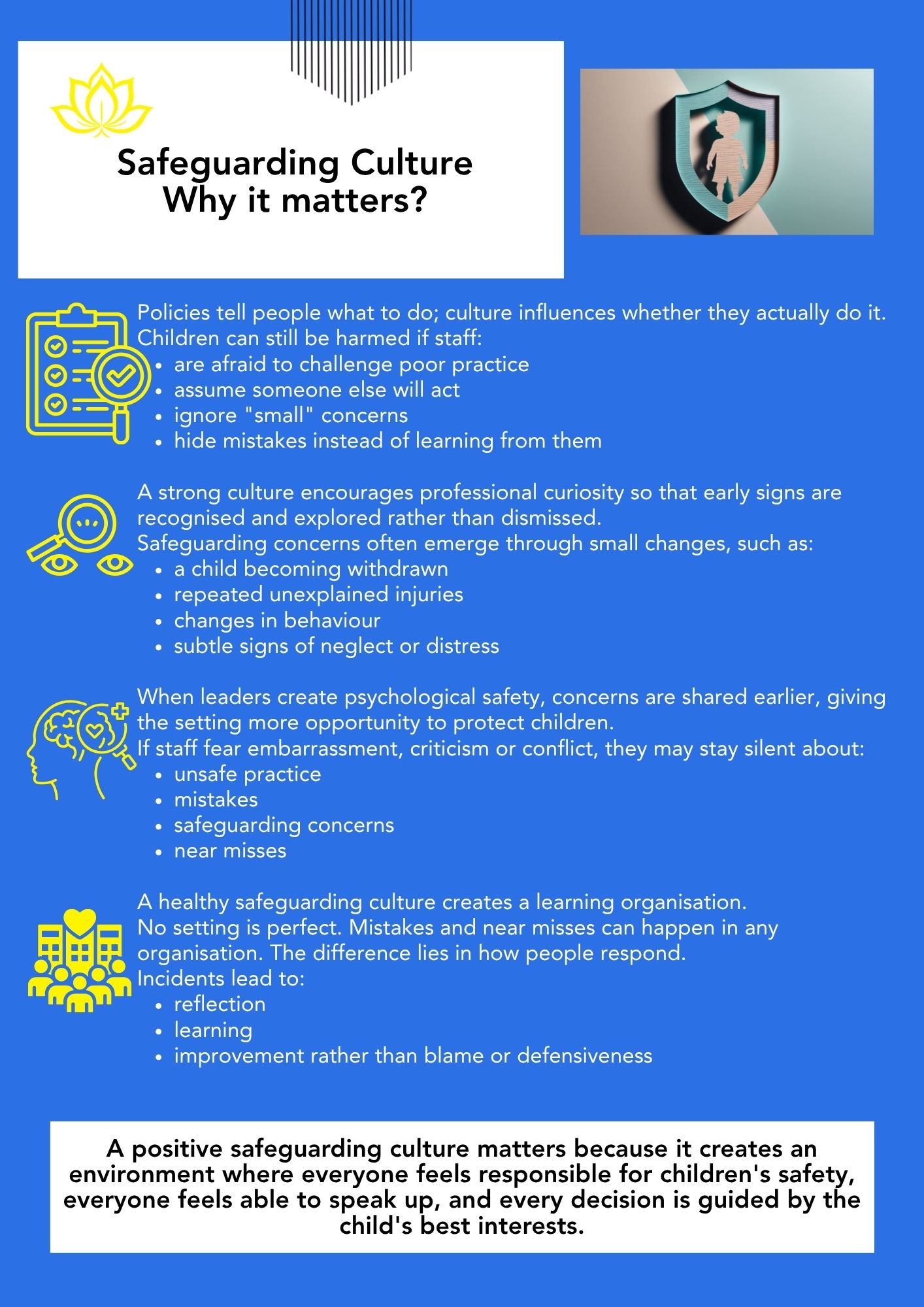
Why does it matter?
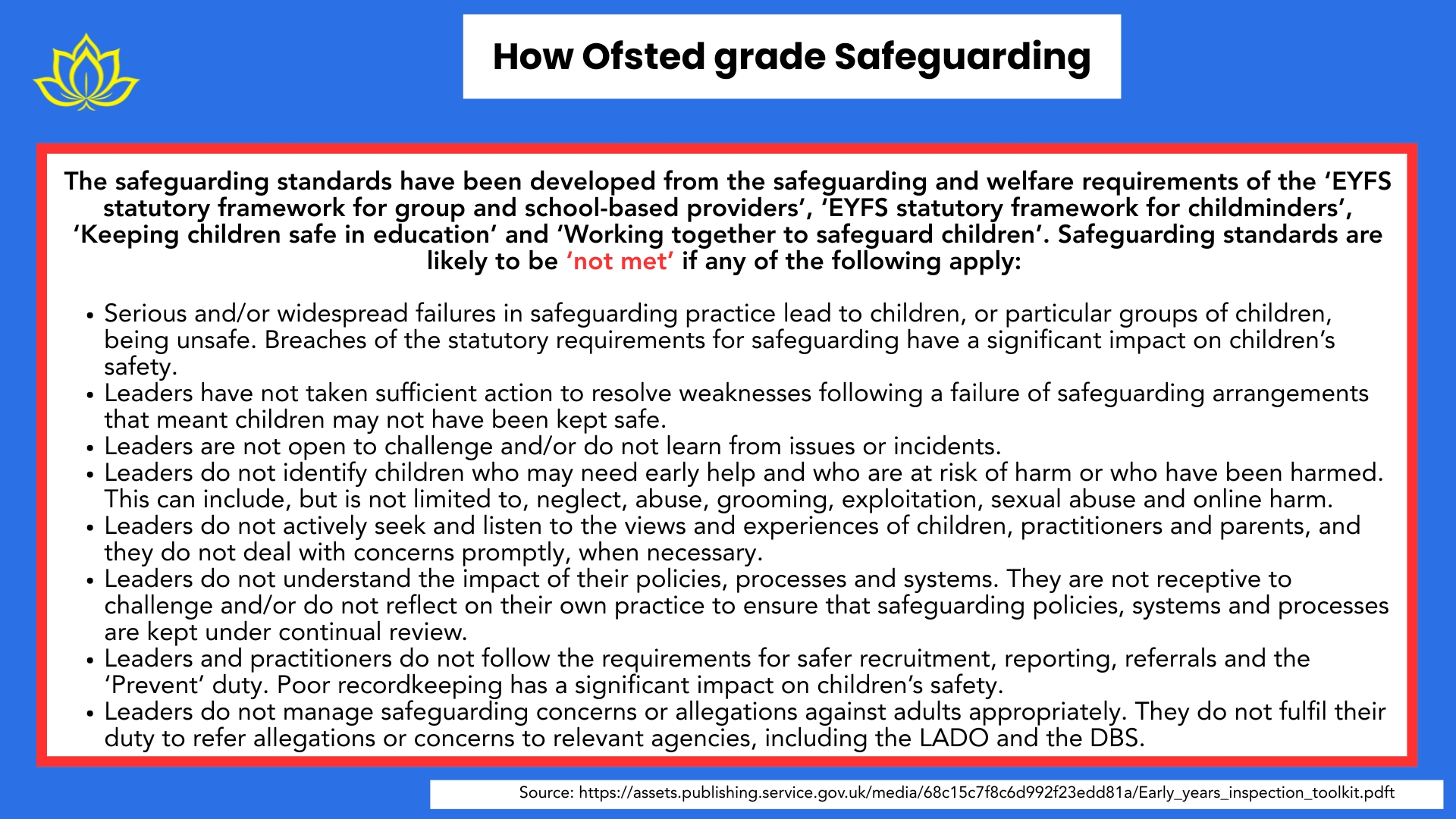
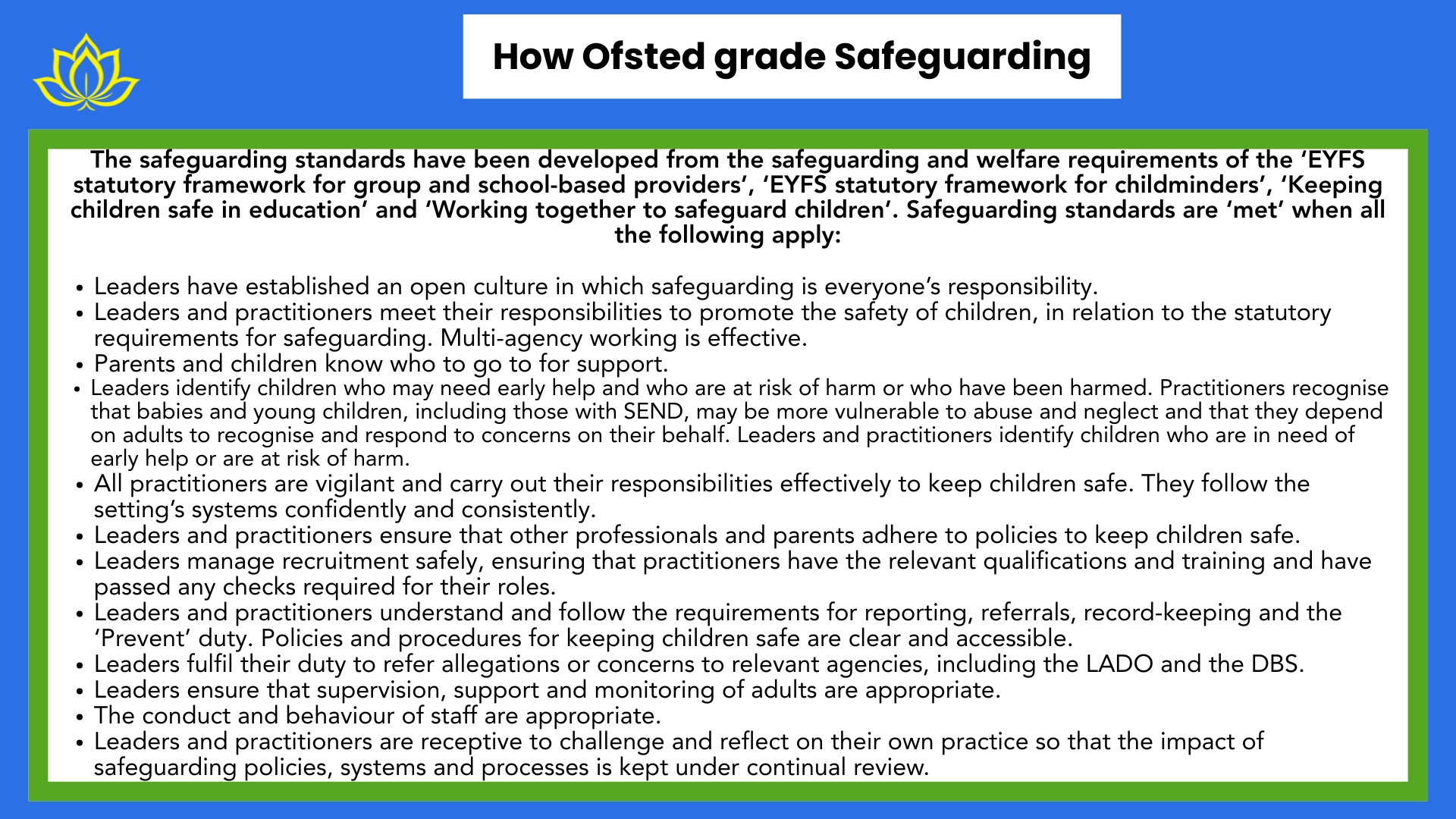
What does Ofsted say?
Page 7 and 8 of this document tell us how Ofsted grade a setting as met or not met for safeguarding.
Put Children First
A useful safeguarding question for leaders is:
Does this have the child’s best interests at heart?
This question can help cut through competing priorities, pressures and emotions.
Putting children first means thinking about safeguarding through several connected ideas.
- Child-centred practice: Children’s interests, voices and views should be heard and respected.
- Children’s rights: Children have a right to safety, care, education, healthcare and protection from abuse and exploitation.
- Professional curiosity: Professional curiosity means asking questions rather than simply accepting what is presented to you. It means trying to understand what is really happening in a child’s life.
- Behaviour as communication: Children will not always have the language to explain what they are experiencing. Their behaviour may be communicating something that they cannot yet say.
- Dignity: Safeguarding also means respecting children’s physical and emotional boundaries, privacy and dignity.
Consider this…
- Imagine you notice a bruise on a child.
- One response might be: “I don’t want to upset Mum by asking where that bruise came from.”
- A safeguarding response is: “I need to understand what has happened so that I can protect this child.”
- Or imagine staffing becomes difficult.
- The question is not simply: “How do we combine the rooms because we are short staffed?”
- It becomes: “How can we deploy the staff we have in the safest possible way for the children?”
Safeguarding leadership requires us to recognise when adult convenience, relationships or discomfort are beginning to compete with children’s welfare.
Task Two: Ask the right questions
Think of a situation where the needs or comfort of adults could compete with the needs of children.
Ask yourself:
- What responsibility do you have as a leader?
- What might make the easier option tempting?
- What would putting the child first look like?
Create Psychological Safety
Psychological safety is the shared belief that people can ask questions, raise concerns, admit mistakes and speak openly without fear of humiliation or inappropriate punishment.
This matters enormously in safeguarding.
If people are frightened to speak, safeguarding risks can remain hidden.
A member of staff needs to be able to say:
- “I’m worried about something.”
- “I don’t think I handled that well.”
- “I noticed something that didn’t feel right.”
- “Can I check whether this is okay?”
- “I think we need to talk about what happened.”
Creating psychological safety does not mean removing accountability.
People still need to take responsibility for their actions.
It means creating a culture where honesty is safer than silence.
Task Three – As a leader, ask yourself
How do I respond when somebody:
- Admits they made a mistake?
- Challenges something I have done?
- Raises a concern about a colleague?
- Questions an established routine?
- Tells me something I do not particularly want to hear?
Your reaction teaches people whether it is safe to speak to you again.
Integrity: Doing the Right Thing When Nobody Is Watching
Safeguarding culture depends on integrity.
Integrity means doing the right thing even when nobody is watching.
In practice this means being:
- Honest.
- Transparent.
- Accountable.
- Consistent.
- Professional.
- Respectful of confidentiality and professional boundaries.
Safeguarding standards should not change because the manager is absent.
For example:
- Are mobile phones stored correctly whether or not the manager is in the building?
- Is the outdoor safety checklist genuinely completed, or simply ticked?
- Are ratios maintained even when doing so is inconvenient?
- Are accidents always recorded accurately?
- Are observations and records truthful?
The small things matter because they communicate what is acceptable.
Small acts of dishonesty can create larger safeguarding risks.
Examples might include:
- Changing dates on observations.
- Ticking a checklist without completing the checks.
- Failing to report an accident because of how it might look.
- Changing a record to make an incident appear less serious.
- Ignoring supervision ratios.
- Walking past poor practice because challenging it feels uncomfortable.
Mistake or concealment?
There is an important difference between: “I made a mistake.” and “I hid a mistake.”
Mistakes can happen. What matters is what happens next.
A healthy safeguarding culture encourages people to report mistakes quickly so that action can be taken.
A poor culture encourages people to protect themselves.
Culture is created by what leaders walk past.
When poor practice repeatedly goes unchallenged, it can slowly become normal practice.
Professional Curiosity
Professional curiosity means not being too quick to accept the first explanation.
It means noticing, wondering, asking and exploring.
You might ask yourself:
- What have I noticed?
- What am I unsure about?
- What might I be assuming?
- Is there more I need to understand?
- What might the child be communicating?
- Is something here not quite adding up?
Professional curiosity is not about being suspicious of everybody.
It is about being willing to investigate rather than overlook.
For leaders, this applies both to children and to staff practice.
When something does not feel right, your responsibility is not to ignore that feeling.
Your responsibility is to understand it.
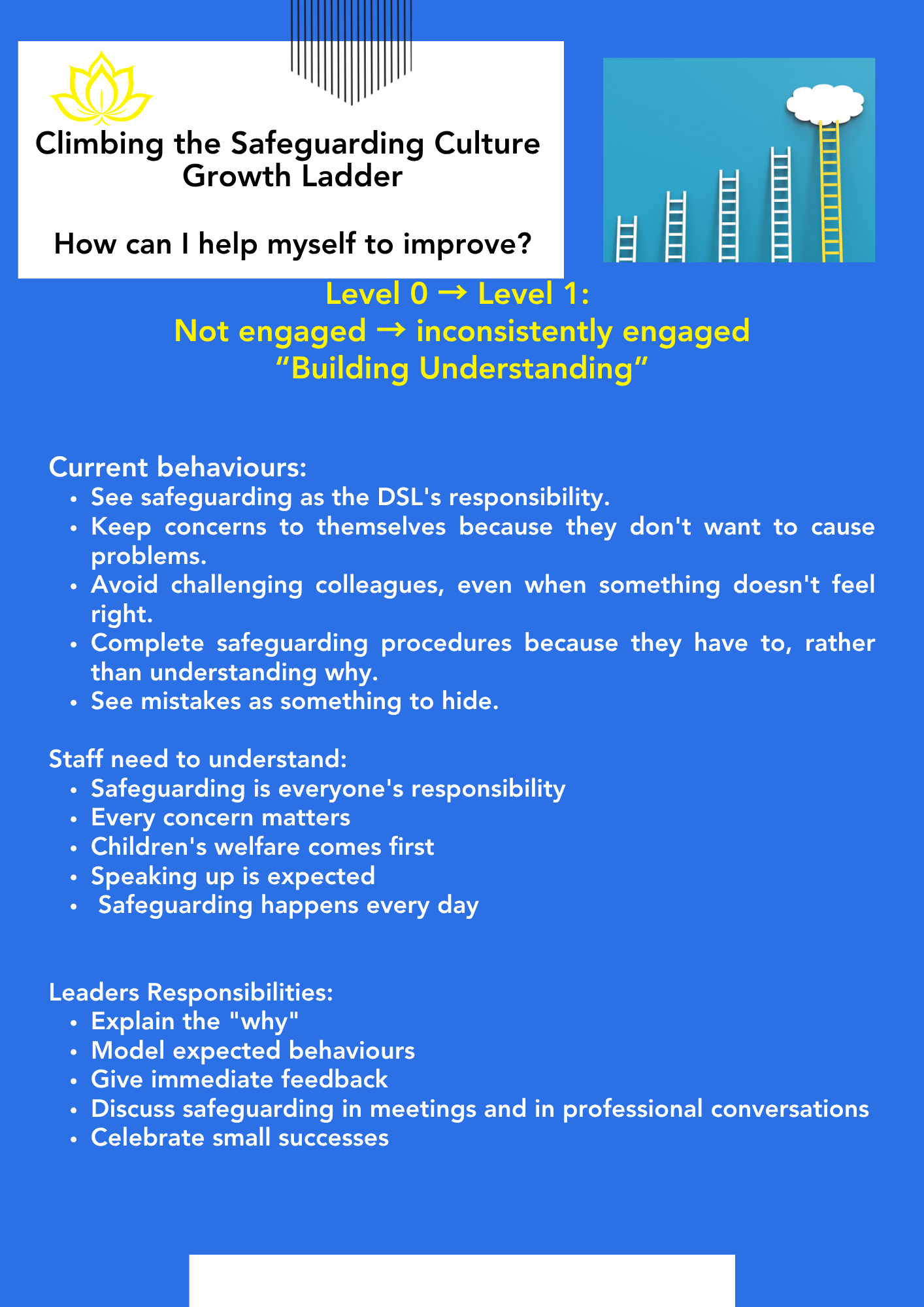
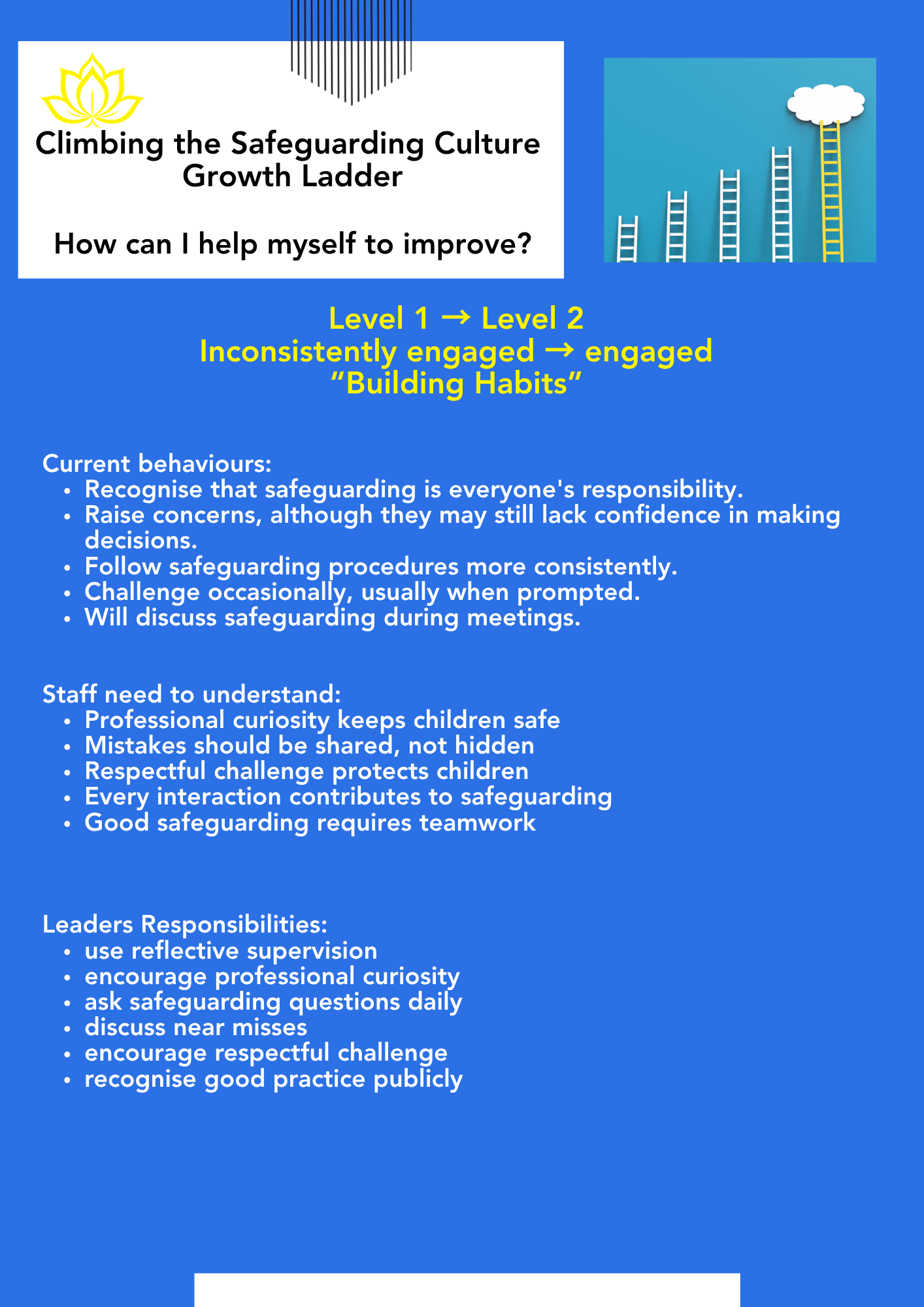
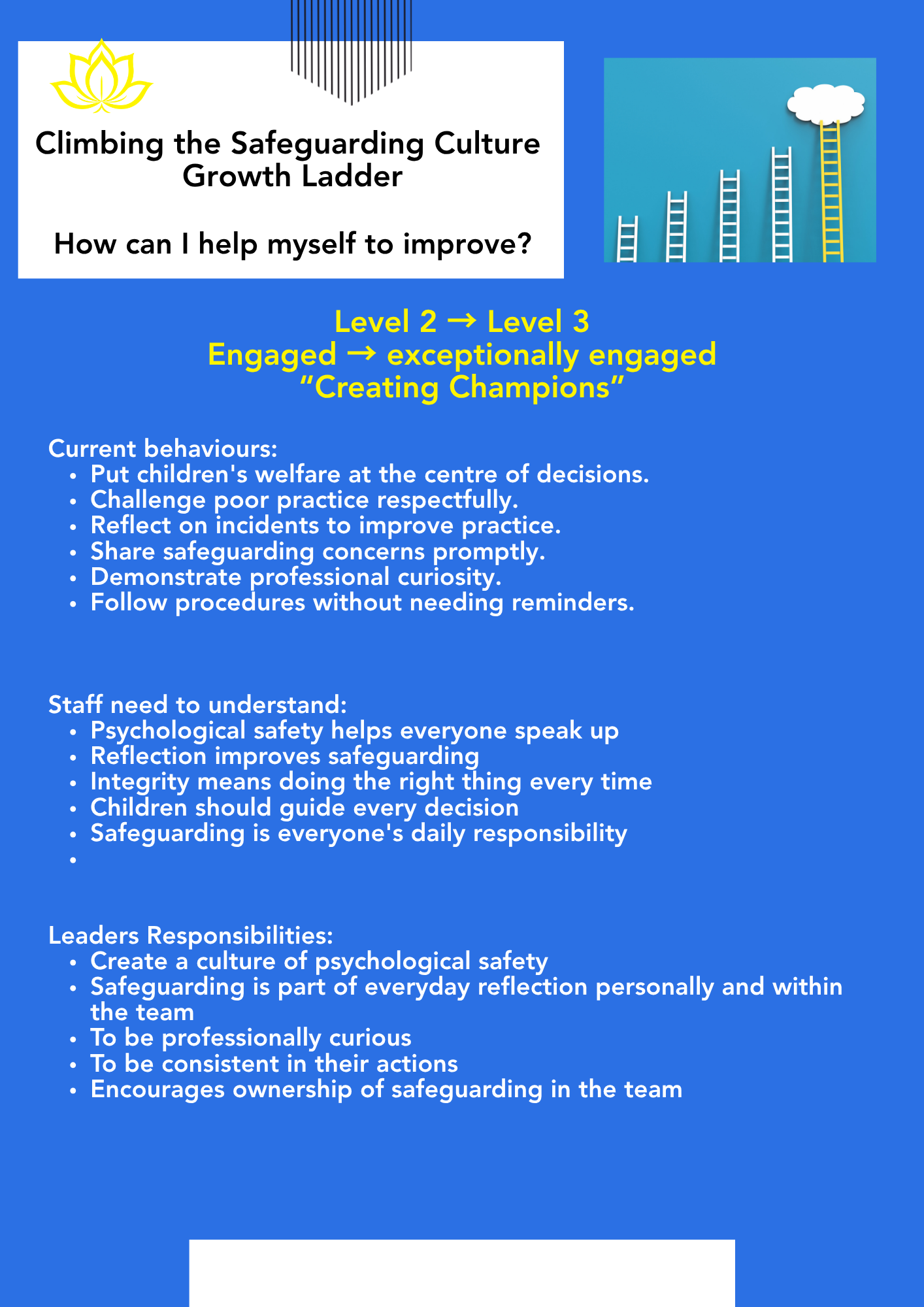
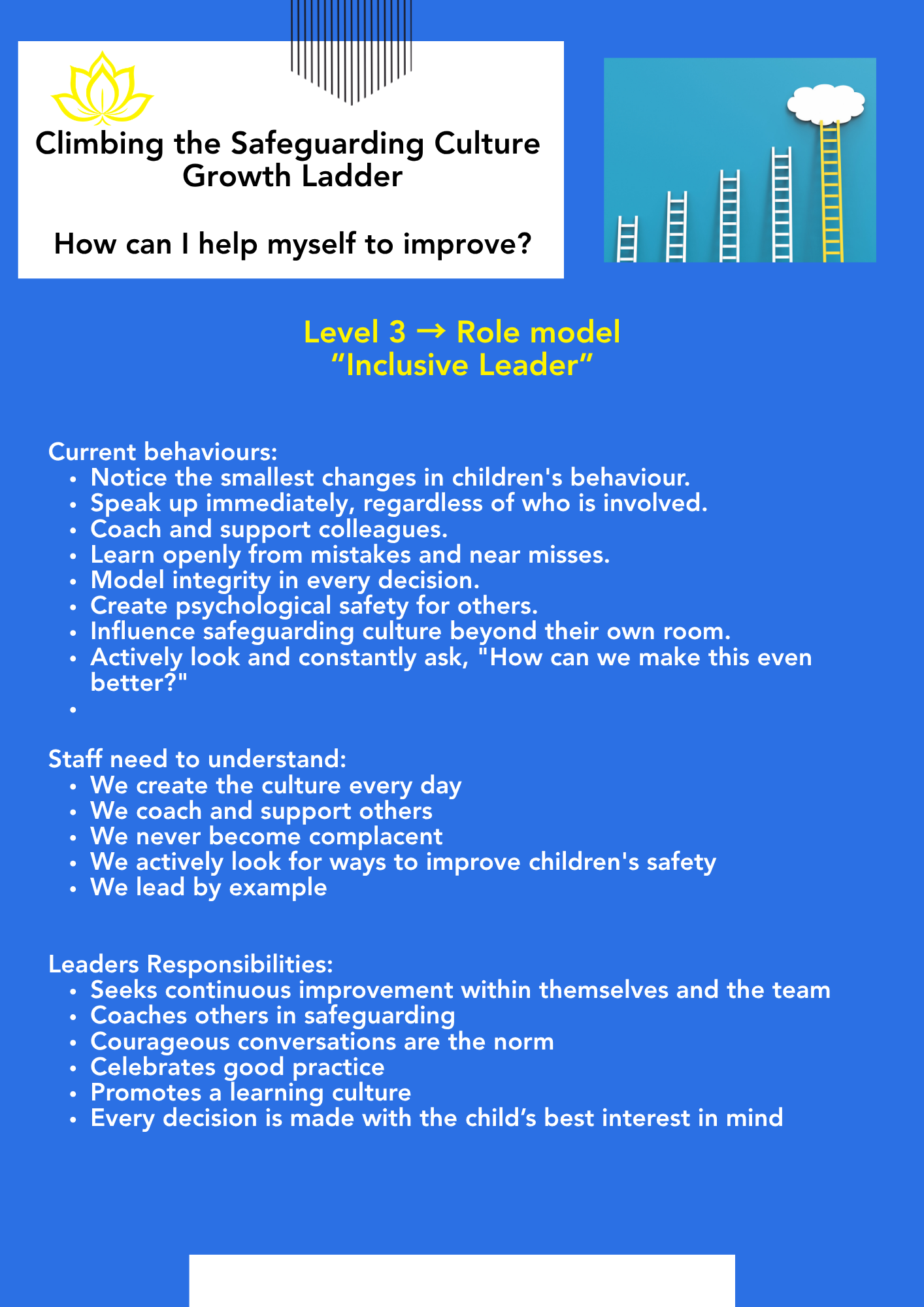
Career growth ladder
Where are you at right now and what’s next for your development?
Speaking Up and Professional Challenge
Safeguarding relies on people being willing to speak.
This can include:
- Professional curiosity.
- Respectful challenge.
- Raising concerns.
- Recording concerns.
- Following safeguarding procedures.
- Escalating concerns where necessary.
- Whistleblowing where appropriate.
Speaking up does not need to begin aggressively.
Simple phrases can open important conversations:
“I noticed…”
“I’m worried because…”
“Can we talk about…”
“I’m not comfortable with…”
“I think we need to discuss this with the DSL.”
Many safeguarding issues escalate because somebody knew a conversation needed to happen but avoided having it.
Leaders need to address concerns early, respectfully and confidently.
Where appropriate, this should be based on evidence rather than assumptions and approached with curiosity rather than blame.
The CARE Framework
The CARE framework can help you structure a professional challenge when you have noticed something in practice.
It is designed to help you address concerns clearly while keeping the conversation focused on learning and improving practice.
CARE stands for:
C – Clarify the concern
A – Ask with curiosity
R – Reflect together
E – Encourage improvement
This is not a substitute for safeguarding procedures.
If a concern is serious, it should be reported and escalated appropriately.
CARE is particularly useful where a professional conversation is needed around practice.
C – Clarify the Concern
Before speaking to somebody, ask yourself:
- What have I actually seen or heard?
- Is this a fact or an assumption?
- Why am I concerned?
- What could the impact be on children?
Avoid labels.
Instead of:
“You were rough when you picked Jamie up.”
Try:
“I noticed earlier that Jamie was lifted quickly by one arm when he was upset.”
The second version describes what was actually observed.
It gives you a clearer starting point for the conversation.
A – Ask With Curiosity
Start by trying to understand.
You might say:
“Can we talk about something I noticed?”
“Can you help me understand what happened?”
“How did you see that situation?”
“Tell me what was happening for you.”
Try to avoid:
- Accusations.
- Labels.
- Assumptions.
- Questions that immediately place somebody on the defensive.
Questions beginning with what and how will often encourage more reflection than questions beginning with why.
R – Reflect Together
Once you understand the situation, explore it together.
Ask:
- What happened?
- What was the impact?
- What does our safeguarding policy expect?
- What could we do differently next time?
The purpose is not to win an argument.
The purpose is to improve practice.
E – Encourage Improvement
Where appropriate, finish by focusing on what happens next.
You might say:
“What support would help?”
“Let’s review this together next week.”
“I appreciate you talking openly.”
Where appropriate, acknowledging somebody’s openness helps reinforce the culture you want.
However, if the issue represents a serious safeguarding concern, follow the appropriate safeguarding procedure and escalate it rather than treating it simply as a coaching conversation.
Task Four – Practice the CARE Framework
Consider the following situation.
You walk into the room and see a practitioner speaking sharply to a distressed child. The practitioner appears frustrated and tells the child:
“Stop crying. There’s nothing wrong with you.”
Before continuing, consider:
Clarify
- What did you actually see and hear?
- What part is fact and what might be assumption?
- What concerns you?
Ask
- How could you begin the conversation without immediately creating defensiveness?
Reflect
- What might you want the practitioner to think about?
- What was the potential impact on the child?
Encourage
- What improvement would you want to see next?
- What support might be appropriate?
Escalate: Is this something that can be addressed through professional challenge alone, or does it require further safeguarding action?
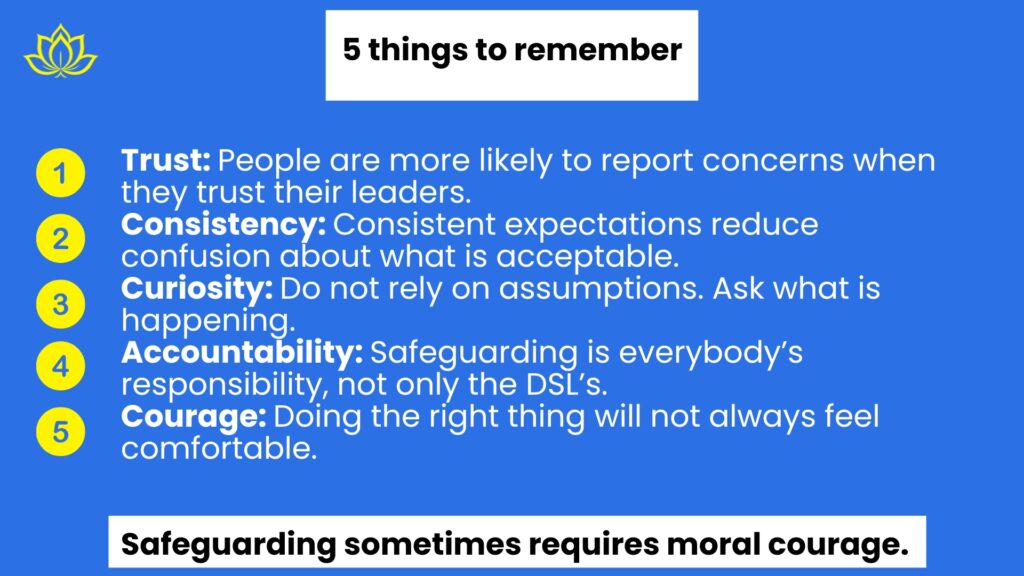
Five Things to Remember
Final Thought
A strong safeguarding culture is visible when:
- Children feel physically and emotionally safe.
- Staff feel psychologically safe.
- Difficult conversations happen early.
- Everybody notices safeguarding.
- Leaders are approachable.
Safeguarding is everyone’s responsibility.
But leaders have a particular responsibility to create the conditions in which everybody else can fulfil theirs.
GIST: Good ideas for starting things
- A Leadership Challenge: Safeguarding culture is not created by one training course. It is created through hundreds of small decisions, conversations and behaviours. Before leaving this course, identify one action you will take to strengthen safeguarding culture within your provision. Complete these sentences:
- Something I want to protect is…
- Something I want to strengthen is…
- Something I need to challenge is…
- One conversation I need to have is…
- One thing my team need from me as their leader is…
- Then decide:
- My next action: What will I do?
- By when? When will I do it?
- How will I know it has made a difference? What will I see, hear or experience differently?
- Make Speaking Up Normal: Speaking up should not depend entirely on one person being unusually confident or courageous. Leaders can make it a shared expectation of the team. One way of doing this is through a Speaking Up Charter.
- For example… In our provision we agree that:
- We put children first.
- We speak up when something does not feel right.
- We challenge respectfully.
- We welcome questions.
- We learn from mistakes.
- We support each other to improve.
- We never ignore a concern because raising it feels awkward.
- We thank people for having the courage to raise concerns.
- This shifts speaking up from being an individual act of courage to being something the whole team expects from one another.
- Create or adapt a Speaking Up Charter for your own provision. Think about:
- What behaviours should your team expect from one another?
- What should somebody do when something feels wrong?
- How should colleagues challenge one another?
- How should leaders respond when concerns are raised?
- What would make staff feel confident that speaking up is valued?
- For example… In our provision we agree that:
Want to know more?
- Read The Fearless Organization – Amy Edmondson: A useful exploration of psychological safety and why people need to feel safe to speak openly within teams.
- The Gift of Conflict: Watch this Ted Talk from Amy Gallo helping you to see conflict differently.