
Leading consistent high performance starts with knowing where your team really stands, then building the habits that keep standards alive long after the initial push has worn off. This lesson walks through the full picture: naming an honest starting point, setting non-negotiables, communicating them clearly, using challenge rather than criticism, modelling them yourself, and building routines that make them stick.
Teams don’t rise to the standard you set. They rise to the standard you live.
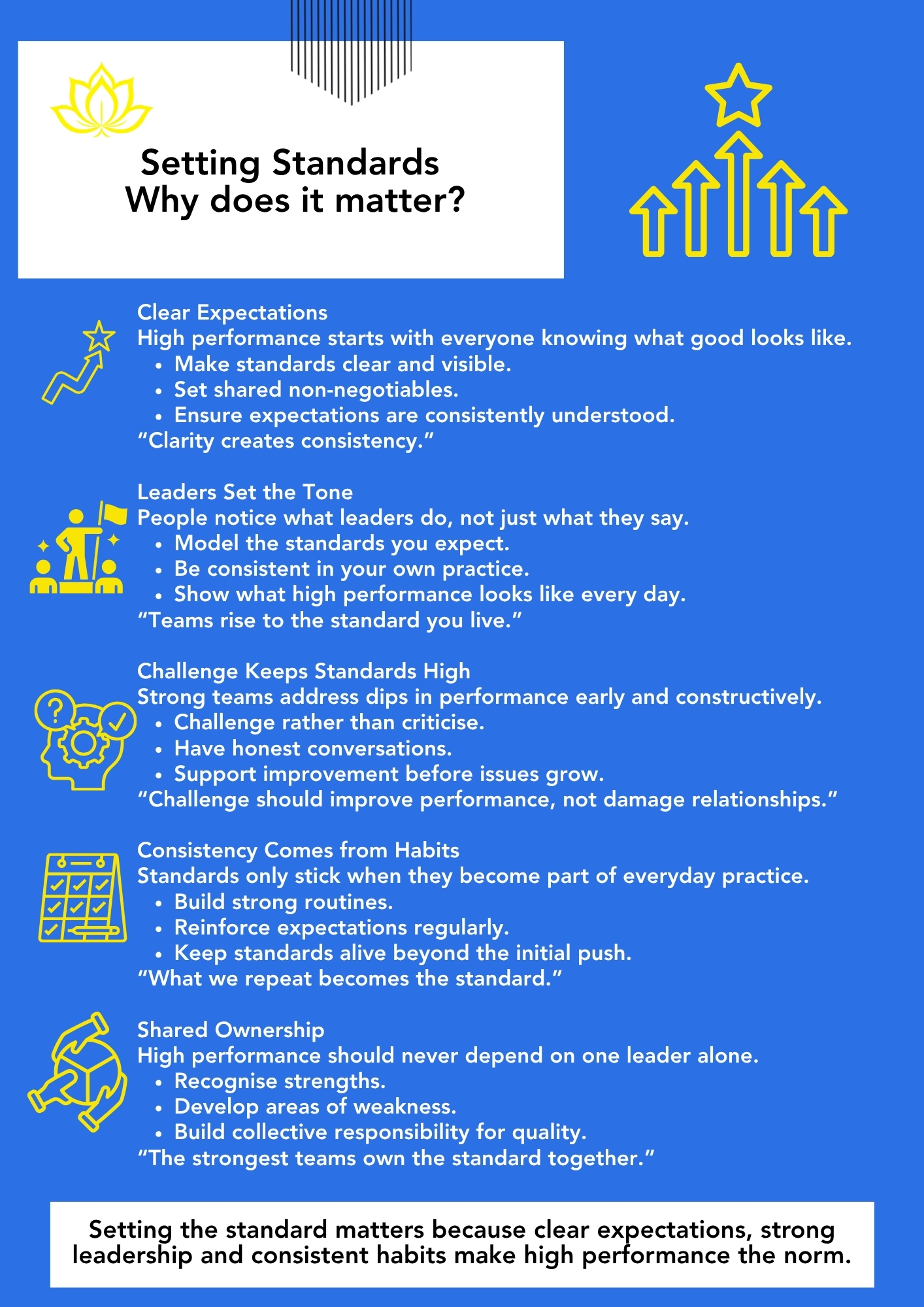
A setting that get’s this right will…
- Make expectations clear, visible and consistently understood.
- Ensure leaders model the standards they expect from others.
- Address dips in performance early, fairly and constructively.
- Build a culture where challenge is normal, respectful and supportive.
- Use people’s strengths while actively developing areas of weakness.
- Create routines that reinforce high-quality practice every day.
- Develop shared ownership of standards so quality does not depend on one leader alone
Why does it matter?
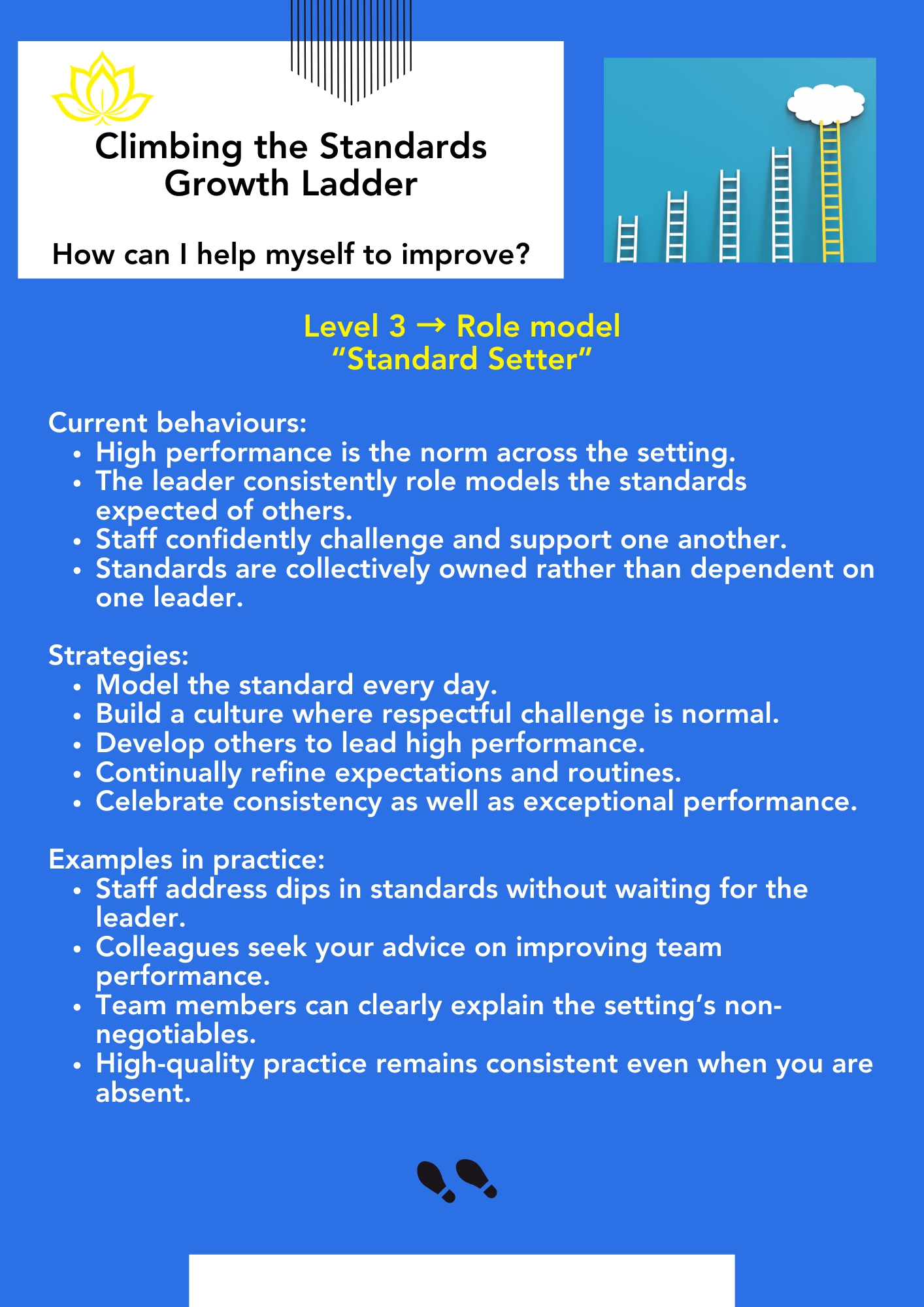
The Standards Growth Ladder
Task One – Honest self-reflection
Before raising standards, rate your team honestly against these four levels. Where you sit determines what to focus on next.
| High performance of all staff is the norm in the setting and this consistency is role modelled by the leader | Sets and achieves consistently high standards of performance across the team showing clear awareness of others development areas and strengths | High standards are not consistently maintained and only some working knowledge of their team is evident in action | High standards are rarely encouraged and only a very limited working knowledge of their team is evident in action |
Discuss this with colleagues too and see if they agree.
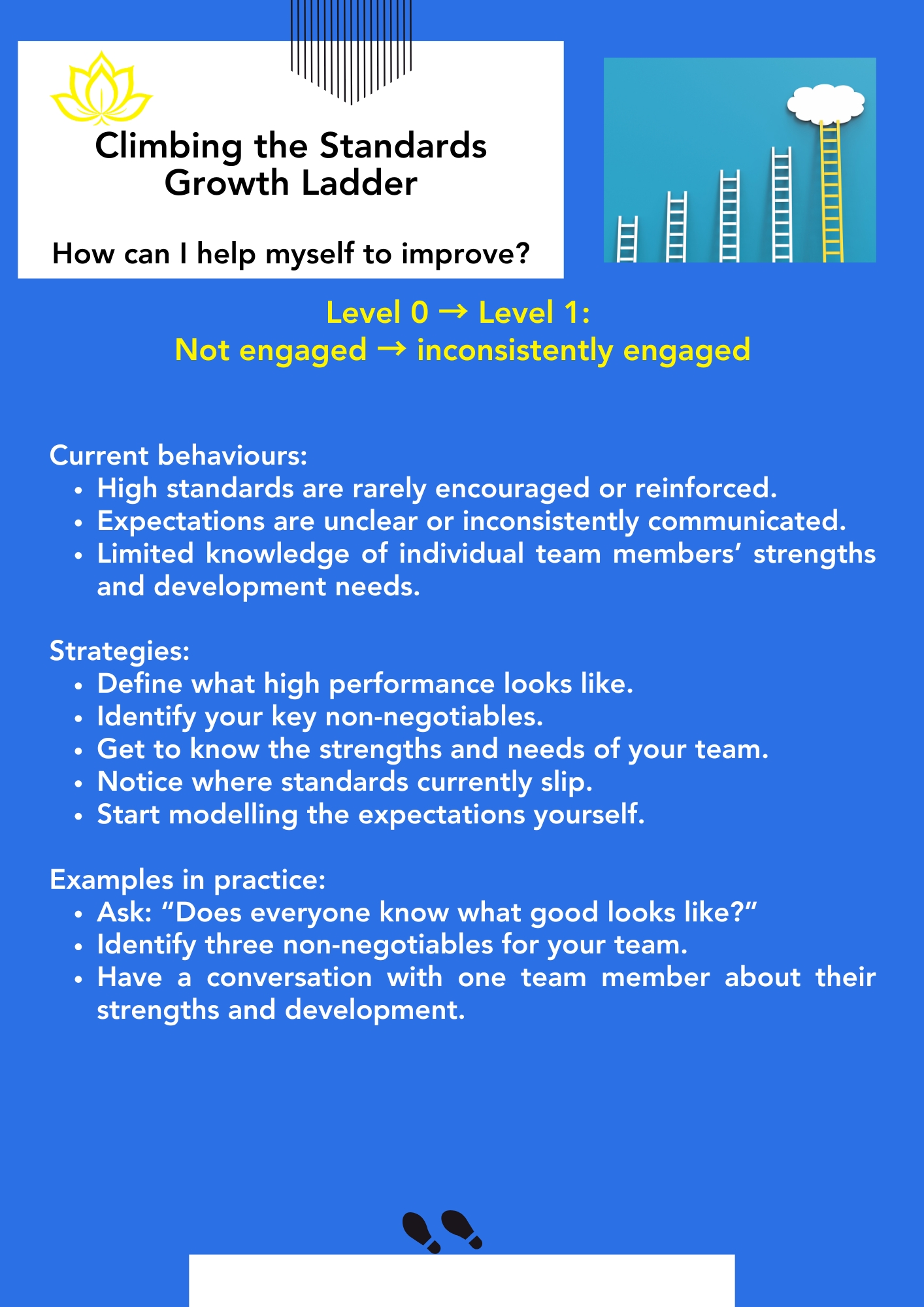
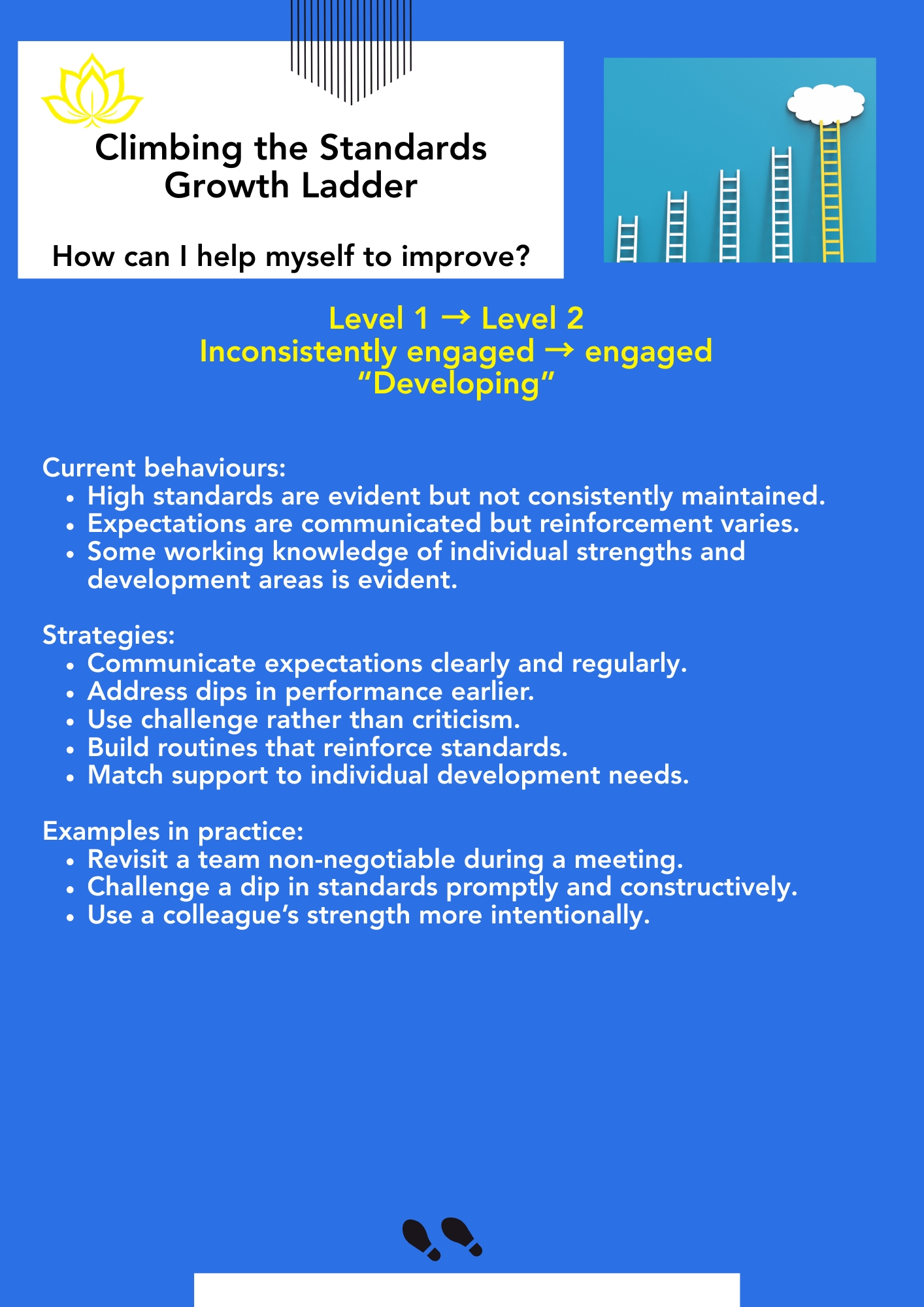
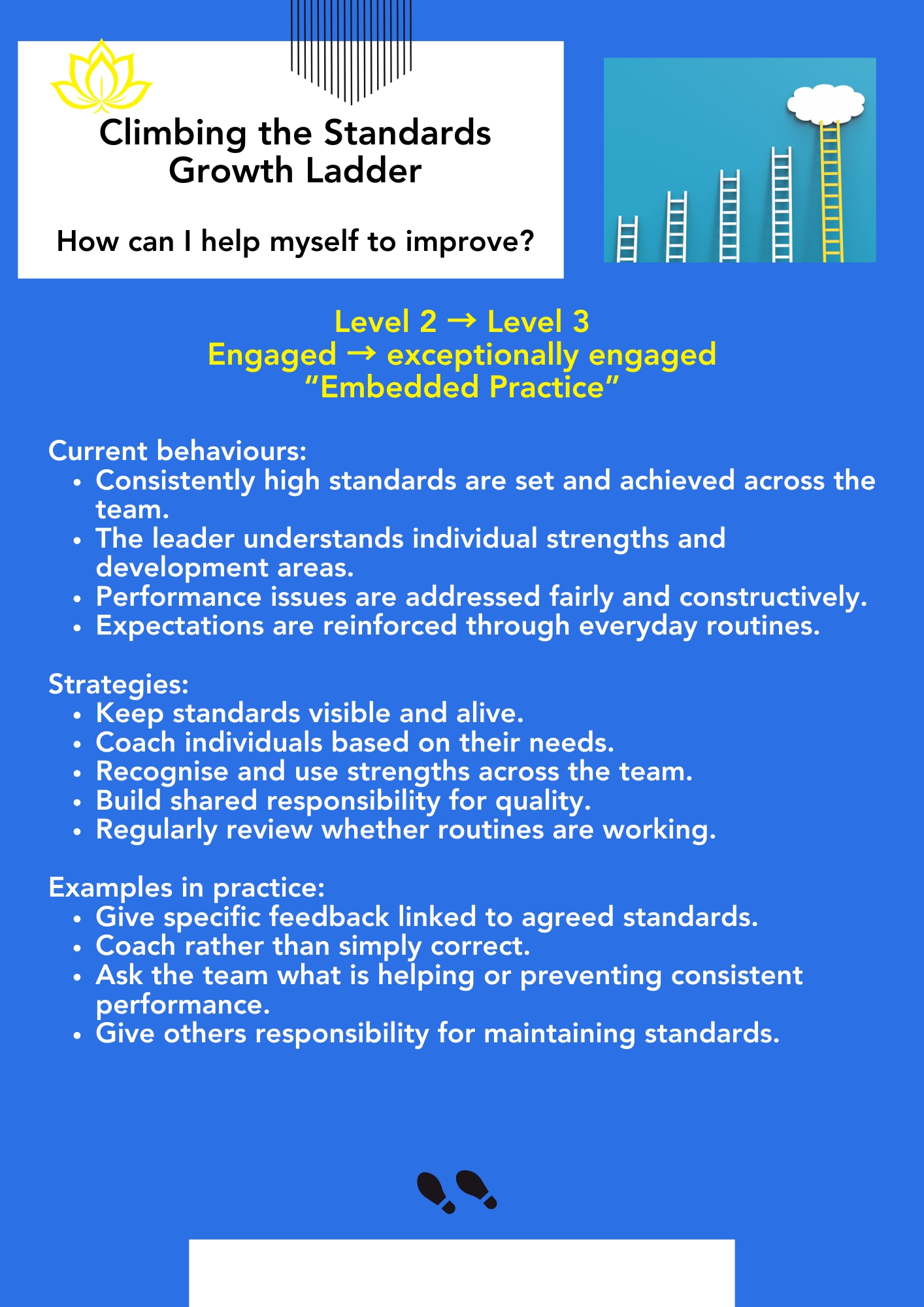
Growth Ladder
Now you know where you are at, let’s see how you can get to the next level with some targeted action…
Defining Your Non-Negotiables
A standard you hold sometimes isn’t really a standard. A non-negotiable is different from a general expectation: it directly affects children’s safety, wellbeing or experience, it applies to absolutely everyone regardless of role or seniority, and it’s something you’d address immediately, every time, if it slipped.
- Safeguarding procedures are followed exactly, every time.
- Every child’s key person knows their current stage and next steps.
- Handovers are accurate and never rushed.
- Concerns about a child or colleague are raised the same day, not left.
If everything is a priority, nothing is a non-negotiable.
This matters because leaders who try to hold everything to the same high bar often end up holding nothing consistently. Non-negotiables work because they’re few, clear, and applied without exception, which makes them easy for the team to remember and impossible to misread.
Keep your own list short: three to five items, each written as a single, unambiguous sentence, shared with your team along with the reasons why they matter. Use the prompts below to help when choosing your own.
Choosing yours…
- List everything you currently treat as important
- Test each one against the details above
- Cut the list down to three to five items, no more
- Write each one in a single, unambiguous sentence
- Share them with your team and explain the why, not just the what
Task Two – The Three-Non-Negotiable Test
- How it works: Ask three different team members, separately, to name your setting’s non-negotiables without prompting them.
- Why it works: If their answers don’t match closely, your non-negotiables aren’t clear yet, no matter how clear they feel to you.
- What’s next: Rewrite any non-negotiable that wasn’t named consistently, using simpler, more specific language.
- Next week/month: Check in again and follow the steps above as needed.
Communicating Standards Clearly
Standards fail in the gap between what a leader means and what a team hears. Vague language, one-off mentions, and inconsistent messages all create room for reasonable-sounding excuses.
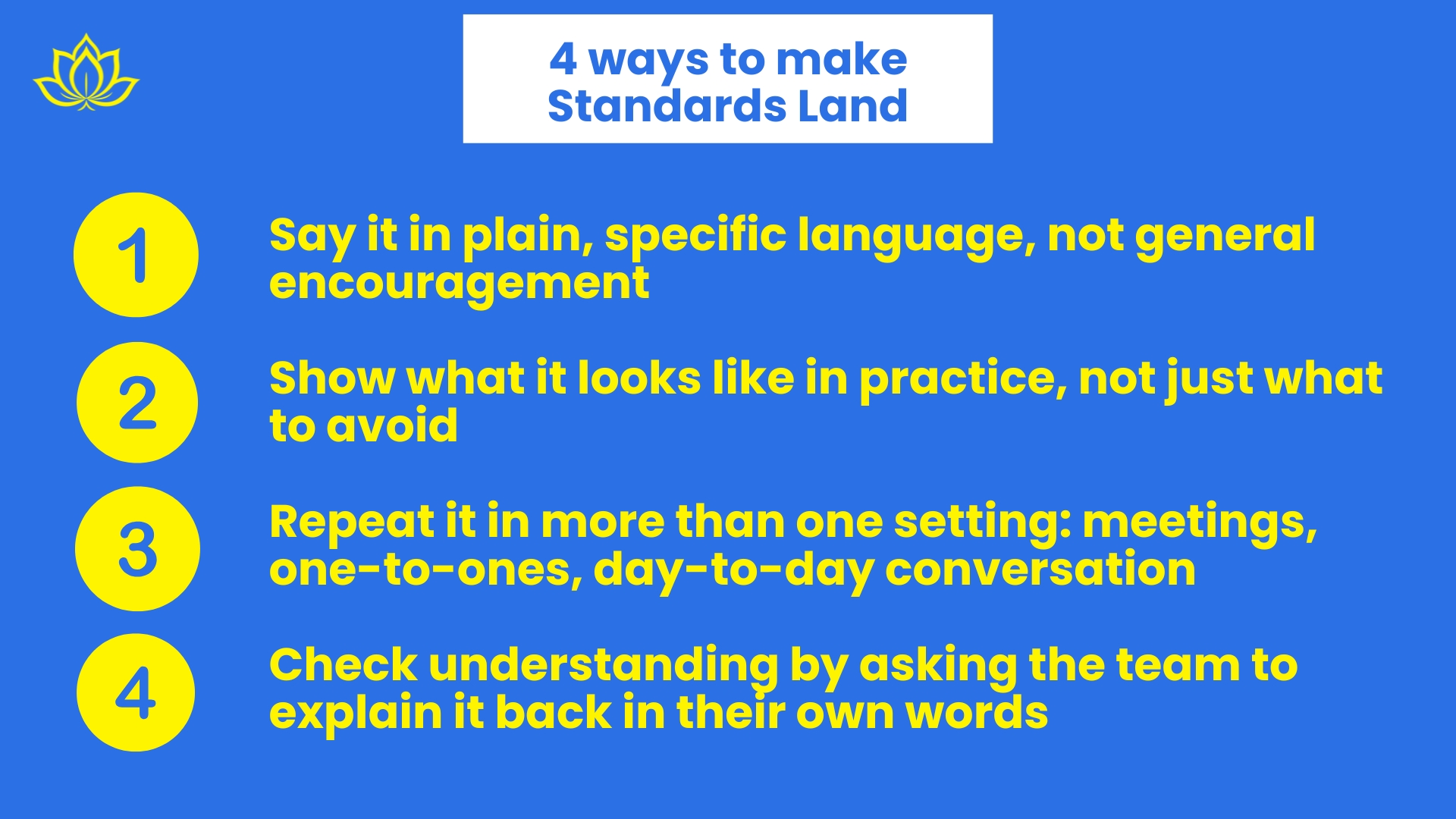
- Say it in plain, specific language, not general encouragement
- Show what it looks like in practice, not just what to avoid
- Repeat it in more than one setting: meetings, one-to-ones, day-to-day conversation
- Check understanding by asking the team to explain it back in their own words
Knowing your standards isn’t enough if the team can’t hear them clearly. This lesson looks at how you put standards into words and actions that are impossible to misunderstand, so nobody can say they didn’t know.
A standard nobody can repeat back to you is a standard that doesn’t exist yet.
How to stop standards getting lost
There are three ways standards can get lost in translation…
1. Vague Language
Phrases like “do your best” or “keep on top of things” sound reasonable but mean something different to everyone who hears them. Replace them with specific, observable descriptions of what good looks like.
2. Low Visibility
A standard mentioned once in an induction pack is not a standard that’s communicated. It needs to be visible and repeated: in meetings, in supervision, in the everyday language you use when you’re in the room.
3. Inconsistent Messages
If the standard changes depending on who’s asking or how busy the day is, the team will quietly learn to ignore it. Consistency in how you communicate a standard is what makes it credible.
Challenge as a Growth Tool, Not Criticism
Criticism looks backwards at what went wrong. Challenge looks forwards at what’s possible.
For example, if a key person has rushed two handovers this week, criticism-led feedback (“You keep forgetting to give proper detail at handovers, this can’t keep happening”) invites defensiveness and gives no way forward. Challenge-led feedback (“I’ve noticed two handovers were rushed this week, what’s getting in the way, and what do you need from me to make sure future ones are not rushed?”) opens a conversation instead of closing one down.
- It’s specific: describe the behaviour or pattern, not a character trait
- It’s timely: raised close to the moment, not saved up for a review
- It’s paired with belief: the person can hear that you think they’re capable of meeting the standard
- It invites a response: a genuine question, not a rhetorical one
Many leaders avoid challenge because it feels like conflict. This lesson reframes challenge as one of the most useful tools you have: a way of helping someone close the gap between where they are and where the standard sits, without it feeling like an attack.
Criticism looks backwards at what went wrong. Challenge looks forwards at what’s possible.
Avoiding challenge doesn’t protect a team, it protects a standard from ever being met. Leaders who confuse challenge with criticism either say nothing and let standards slide, or say something harsh and damage trust. Learning to challenge well means you can do neither.
Task Three – Rewrite the Criticism
- How it works: Think of a piece of feedback you gave recently that leaned towards criticism. Rewrite it as a challenge, using the four qualities above.
- Why it works: Rewriting after the fact builds the habit of catching yourself before a criticism-led comment leaves your mouth in future.
- What’s next: Notice the next moment you’re tempted to criticise, and try the challenge-led version in real time.
Role Modelling Standards as a Leader
A standard you don’t meet yourself is a standard you’re only borrowing authority to enforce. Every team watches what their leader does far more closely than what they say, so the moment your own practice slips below the standard you’re asking for, it quietly becomes optional for everyone else too.
- Don’t hold the team to a standard you quietly excuse yourself from
- Be visible when the standard is hardest to hold, not just when things are going well
- Be honest when you fall short, and show what you’re doing differently
Where Role Modelling Breaks Down
- Holding the team to a standard you quietly excuse yourself from “because you’re busy leading”
- Being visible when things are going well, and absent when the standard is hardest to hold
- Explaining the standard often, but rarely being seen actually doing it
- Making a one-off exception for yourself and assuming nobody notices
What Strong Role Modelling Looks Like
It’s not about being perfect. It’s about being visibly consistent, and honest when you fall short. A leader who says “I got that handover wrong yesterday, here’s what I’m doing differently” models the standard more powerfully than one who never admits a lapse at all.
Building Routines That Sustain Performance
What Makes a Routine Sustain a Standard
- It’s built into something that already happens regularly, not an extra task on top
- It has a clear, small trigger: a time, a meeting, a moment in the day
- It’s visible to the team, not just tracked privately by the leader
- It survives you being away, because it doesn’t depend on you personally running it
Examples of Sustaining Routines
A two-minute standards check at the start of every team meeting. A rotating focus for supervision conversations that always includes one standards question. A five-minute walk-round at a set time each day that makes a non-negotiable impossible to overlook. None of these rely on remembering, they rely on the routine doing the remembering for you.
Try This: Build One Routine
How it works: Pick one standard from this course that matters most to you. Attach it to something that already happens every day or every week, rather than creating something new.
Why it works: Standards that ride on an existing routine survive busy weeks. Standards that depend on a separate new habit are usually the first thing to drop.
What’s next: Tell your team what the routine is and why it exists, so it’s visibly theirs too, not just something you do quietly in the background.
GIST – Good ideas for starting things
- The Mirror Check
- How it works: Pick one non-negotiable you hold your team to. Track your own adherence to it, honestly, for one week.
- Why it works: Most leaders assume they’re modelling a standard until they actually track it, and the gap between assumption and reality is where credibility quietly leaks away.
- What’s next: Where you found a gap, name it to your team before they name it to you.
- Bring It Together
- How it works: Pick one standard that matters most right now. Rate your team’s current level on the growth ladder, write the standard as a single non-negotiable sentence, and attach it to an existing routine rather than creating a new one.
- Why it works: Standards that are honestly rated, clearly worded, and carried by a routine are far more likely to survive a busy week than standards that rely on memory or willpower alone.
- What’s next: Share the standard with your team, explain the why behind it, and check back in a few weeks using the growth ladder to see how far you’ve moved.
Want to learn more?
- Listen to this podcast on ‘Being the Leader you want to be.
- If you want to go deeper, try one of the books below…