
A setting who gets this right will…
- Have a calm and organised atmosphere where staff are confident but not rushed.
- Have staff who regulate themselves first, thereby fostering emotional stability in
children. - Have staff who are aware of the impact of everything they do is seen, and
therefore, children learn self-awareness because it is modelled every day. - Have staff who are responsive rather than reactive to children’s behaviour.
- In a self-aware setting:
- All children receive equal attention and respect.
- Staff challenge their own assumptions.
- Cultural differences are valued, not judged.
- The language used in the setting is respectful, child-centred, and free of labels or
negative assumptions.
I think self-awareness is probably the most important thing towards being a champion. Billie Jean King
What is Self-Awareness
Recognising one’s own emotions, thoughts, values, and behaviour.
Why does it matter?
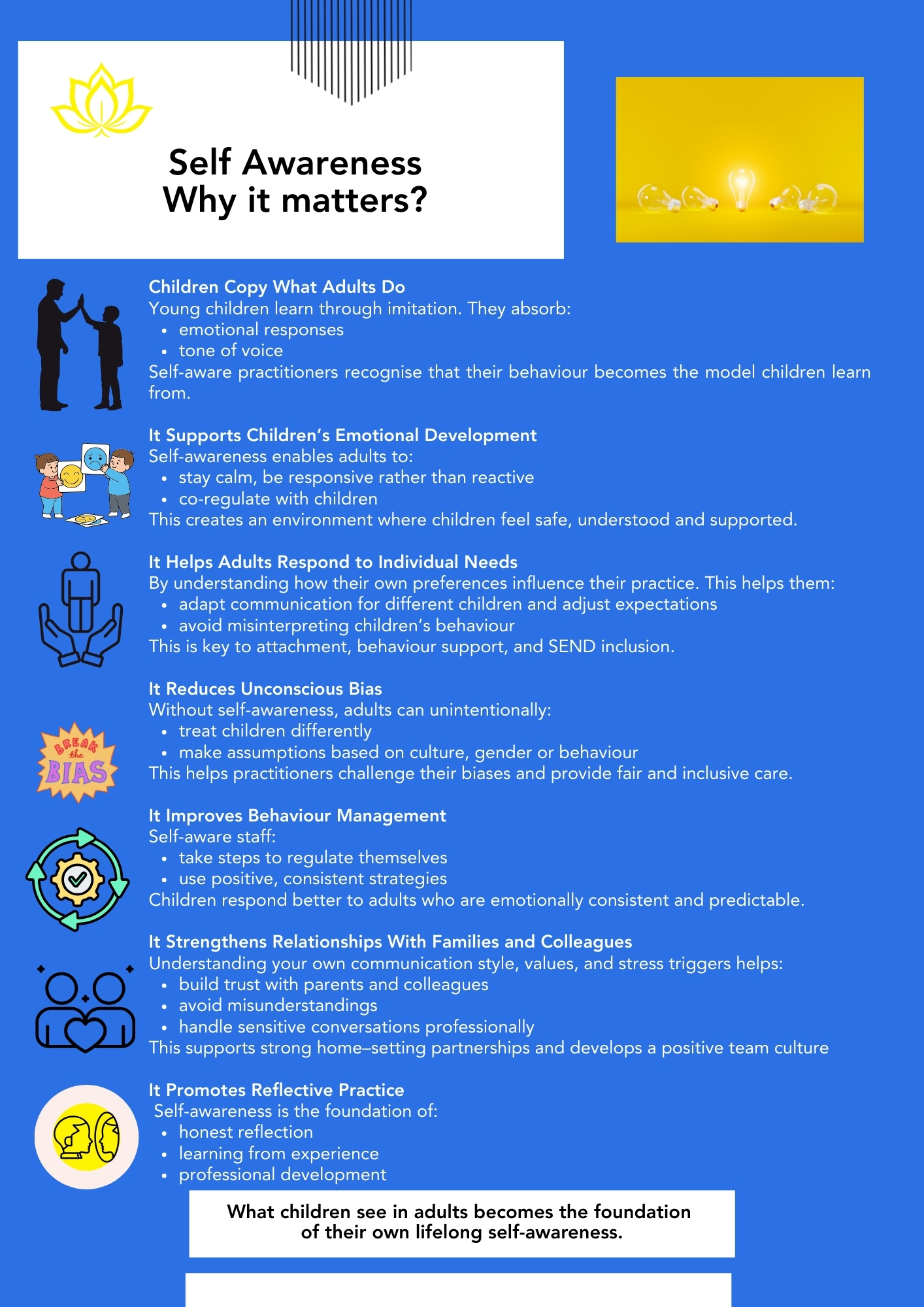
What are the benefits?
- It helps us to name and understand emotions and develop emotional regulation
- It helps us to recognise personal bias and beliefs
- To understand behaviour and the impact of communication styles used
- Develop professional boundaries and attitudes
- To use reflective practice
- To understand the importance of self-care and wellbeing
- To help working relationships
- To build professional identity and growth
- To create a positive impact on children and their learning
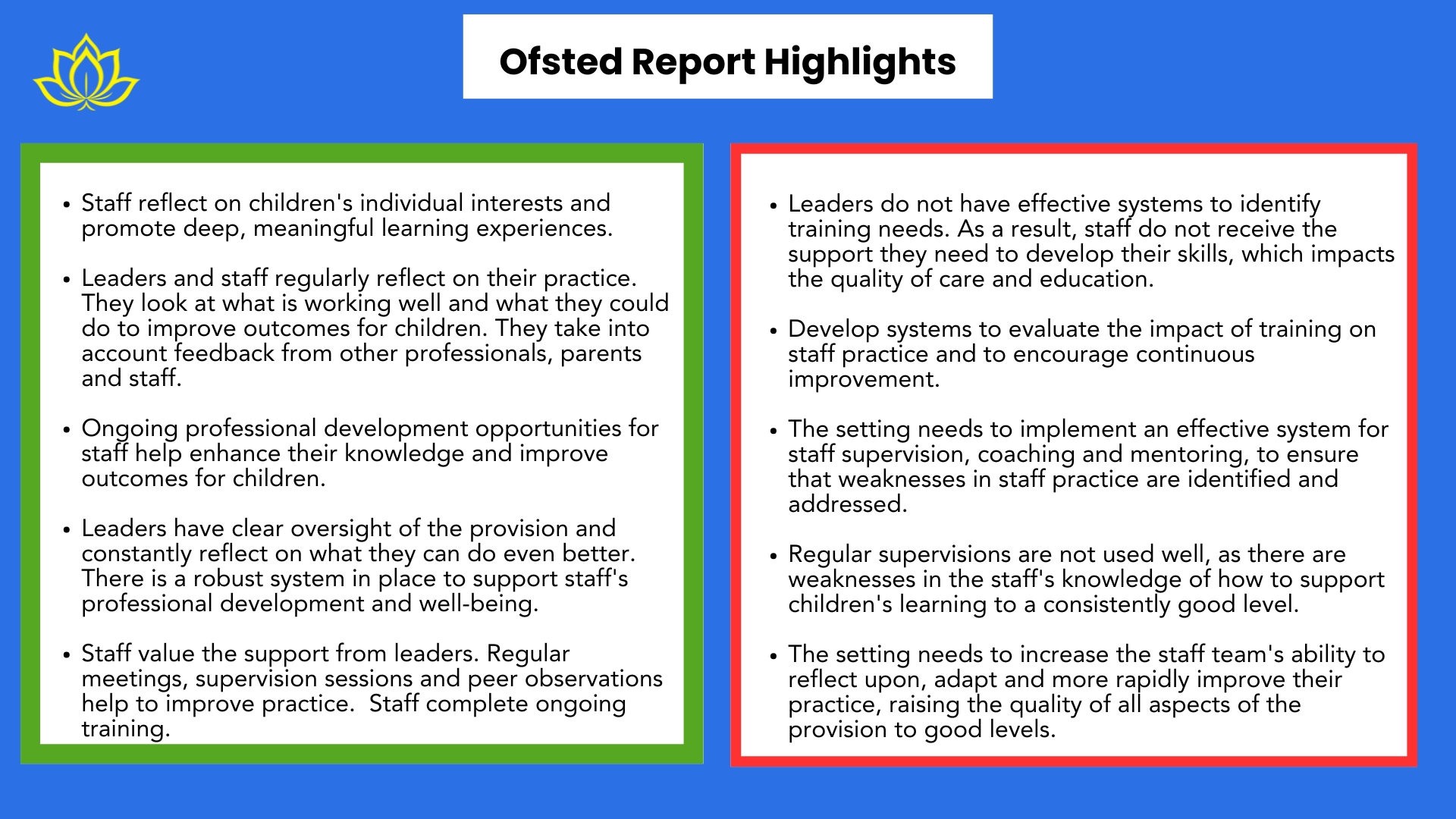
What do Ofsted say about this?
Task One – Reflection
Where do you see yourself with self-awareness currently?
| Full awareness of strengths and proactive actions towards growth | Clear awareness and understanding of strengths and areas for development | Some understanding of areas of weakness and for development | Very little understanding of areas of weakness and for development |
Discuss this with your colleagues to take your reflection deeper, and help them to reflect too.
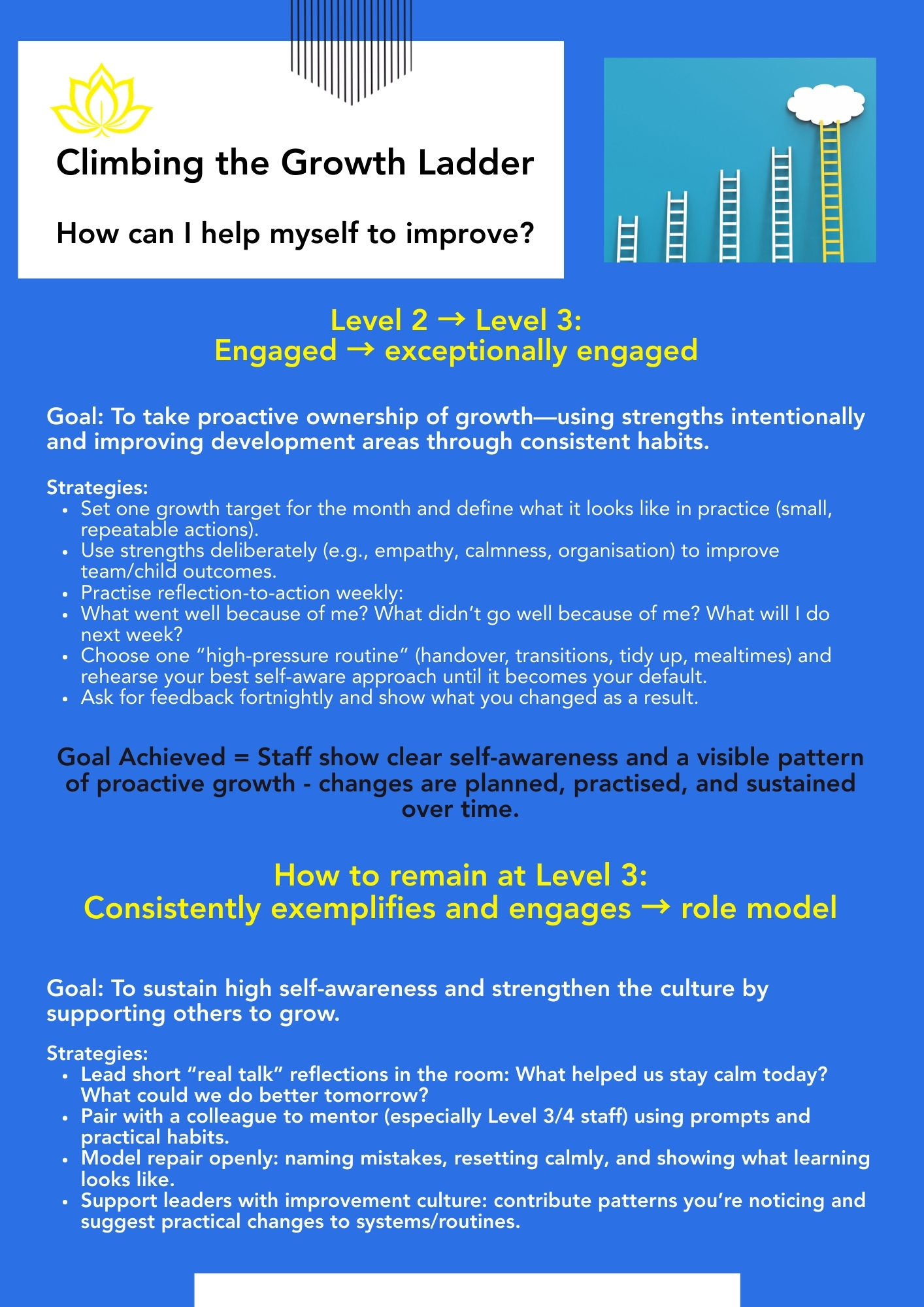
How to progress through the levels

Whenever you are about to find fault with someone, ask yourself: what fault of mine most nearly resembles the one I am about to criticise?’ Marcus Aurelius
Self-awareness is our capacity to stand apart from ourselves and examine our thinking, our motives, our history, our scripts, our actions, and our habits. Stephen R Covey
Common challenge 1: Responsive vs Reactive
Task Two – Emotional Check in Journal
Purpose: Build awareness of emotional triggers and regulation.
Instructions:
- At the end of each day, write down:
- One moment you felt calm and in control.
- One moment you felt stressed, impatient, or overwhelmed.
- What triggered each feeling?
- How did your emotional state affect the children?
- What could you try next time?
Review your notes weekly for patterns.
Some scenarios to work through
Here is a scenario run-through: A chance to consider “What would you do next?” and to go a bit deeper than this to consider what you might be feeling and what would a self-aware response look like.
Parent challenge at the door
- Situation: It’s drop-off. A parent stops you and says (in front of others):
- “Why wasn’t my child’s accident form done yesterday?”
- Or: “My child said you didn’t help them at lunchtime. What’s going on?”
- You’re also short-staffed and two children are upset behind you.
- What might you be feeling? (self-check)
- Pressured / rushed
- Defensive (I did do it!)
- Embarrassed (others are listening)
- Worried (what if it escalates?)
- Frustrated (this is not the moment)
- What’s the risk if you’re not self-aware?
- Snapping, blaming, or sounding dismissive
- Sharing too much information in public
- Breaking rapport and trust
- Missing children’s immediate needs nearby
- Escalating a manageable concern into a complaint
- A self-aware response looks like…
- Step 1 — Regulate first (2 seconds)
- One slow breath. Drop shoulders. Soften face.
- Step 2 — Acknowledge + protect confidentiality Model response (calm, respectful):
- “Thank you for telling me — I can hear this has worried you.”
- “I want to give this the time it deserves, and I also need to keep the doorway calm and private.”
- Step 3 — Offer a clear next step (choice + time) Model response options:
- “I can give you two minutes now to hear the main concern, and then we’ll book a quick chat at 3:30 so we can go through it properly.”
- “I’m going to ask [colleague] to cover the room for a moment so I can listen properly — is that okay?”
- “Would you prefer a phone call later today, or a quick face-to-face at pick-up?”
- Step 4 — If you don’t know yet, say so without sounding evasive
- “I don’t want to guess. I’m going to check the facts and come back to you today.”
- Step 5 — Close warmly
- “I’m glad you raised it. We care about getting this right.”
- Step 1 — Regulate first (2 seconds)
- If the parent continues in the doorway… Model boundary line: “I hear you — and I’m going to move us to a private space so we can talk respectfully and properly.”
Child who refuses tidy-up
- Situation: It’s tidy-up time. You’ve asked the group to tidy. One child stays playing and says “No!” They ignore you, or shout, or throw something when you repeat the request.
- What might you be feeling? (self-check)
- Irritated (“Why are they always the one?”)
- Anxious about time
- Concerned about looking “in control”
- Tired / overstimulated
- Tempted to make it a power battle
- What’s the risk if you’re not self-aware?
- Over-controlling or shaming (“Fine! You’re not going outside then!”)
- Escalating into a battle
- Missing the child’s need (transition, regulation, ownership, predictability)
- Other children copying the conflict pattern
- You “tidy for them” to end it quickly (short-term win, long-term loss)
- A self-aware response looks like…
- Step 1 — Regulate (one breath + soften voice)
- Remind yourself: “This is a transition problem, not a bad child problem.”
- Step 2 — Connect before you correct Model response:
- “You really want to keep building — you’re not ready to stop.”
- “It’s hard to change jobs when you’re in the middle of something important.”
- Step 3 — Give a boundary + choice (simple, doable) Model response options:
- “It’s tidy-up time. You can tidy the blocks or the cars — you choose.”
- “You can do five pieces, then I’ll help with the rest.”
- “Do you want to be the basket leader or the line leader after tidy-up?”
- Step 4 — Make success easy (scaffold the first step)
- “Let’s do the first one together.” (Pick up one item calmly.)
- “Show me where the first block goes.”
- Use less words, not more,
- Step 5 — If they still refuse, stay calm and predictable Model response:
- “I’m going to help you get started. We’re doing tidy-up now. (Then calmly guide: hand-over-hand only if appropriate and safe, otherwise provide proximity support and minimal language.)
- Step 6 — Praise the process, not the person
- “You did it — you started even though it was hard.”
- “That was a good switch.”
- Step 1 — Regulate (one breath + soften voice)
- Repair line (if you got snappy): “I was getting frustrated. That’s not your fault. Let’s try again together.”
Colleague’s tone becomes sharp
- Situation: A colleague speaks sharply to a child:
- “Stop it right now!” / “How many times do I have to tell you?”
- You see the child shrink, or the room atmosphere changes. You also notice your own reaction.
- What might you be feeling? (self-check)
- Protective of the child
- Angry / judgemental (“That’s not okay”)
- Uncomfortable (conflict avoidance)
- Worried about team culture
- Anxious about “calling someone out”
- What’s the risk if you’re not self-aware?
- You ignore it and it becomes normalised
- You confront publicly and shame your colleague
- You become passive-aggressive
- You lose trust either with children or with staff
- You carry resentment and it leaks into interactions later
- A self-aware response looks like…
- Step 1 — Protect the child + regulate the room (in the moment) Model response (gentle, neutral):
- To the child (calm voice): “Come with me a moment.” / “Let’s do this together.”
- To the room: shift attention, bring calm back without drama.
- Step 2 — Support your colleague without shaming (in the moment) Model “team save” line (quietly, nearby):
- “I’ve got this — do you want to take a breath / grab a drink?”
- “I can take over for two minutes.”
- Step 3 — Private follow-up conversation (as soon as possible) Use a calm, professional script:
- Acknowledge pressure: “That was a tough moment. It’s been full-on today.”
- Describe what you saw (no labels): “I noticed your voice got sharper with [child] during tidy-up.”
- Describe impact (child + room): “When that happens, they tend to shut down and the room feels tense.”
- Offer support + a shared approach: “What was going on for you in that moment?” “Next time, do you want me to step in earlier so you can reset?” “Could we try ‘pause–connect–guide’ as our shared script?”
- Step 4 — Repair for the child (if needed) Model response (simple, genuine):
- “I didn’t like how that sounded. I’m sorry. Let’s try again.” This models accountability and emotional safety.
- If you are not the leader Model phrase to keep it respectful: “Can I share something I noticed? I think it could help us keep the room calmer.”
- Step 1 — Protect the child + regulate the room (in the moment) Model response (gentle, neutral):
I am sure you have all experienced these moments above, what other scenarios could you consider yourself or with your team?
Common Challenge 2: Bias and Language
Task Three – ‘Freeze Frame’ Incident Reflection
Purpose: Build awareness of automatic reactions and choices.
Instructions:
- Choose a challenging moment from the week e.g., conflict between children, transition stress, refusal to follow directions and answer:
- What was happening around me?
- What was I feeling?
- What did I do first? Why?
- How did the child respond?
- Could I have acted differently?
- What would a colleague observing me have noticed?
Reflect on your responses alone then with a colleague for support too.
Common triggers in nursery life — and how to stay self-aware anyway
Self-awareness isn’t about being perfect. It’s about noticing sooner, resetting faster, and repairing when needed.
1) Competing adult demands (parents, colleagues, admin)
When this shows up: you feel pulled in three directions, your tone sharpens, you rush, you stop listening properly.
If this is you, try… the “Name + Next” reset (10 seconds)
- Name: “I’m being pulled in a few directions right now.”
- Next: “My next best step is…” (choose one)
- Child safety/needs first
- A quick handover to a colleague
- A clear time promise to the parent (“I can give you 2 minutes now, or 10 minutes at 3:30.”)
Why it works: it reduces overwhelm by making one clear choice and communicates calmly.
2) Time pressure / understaffed moments
When this shows up: you go into “task mode,” talk less, control more, and you start reacting instead of responding.
If this is you, try… the “Slow is Smooth” micro-plan (30 seconds)
- Pick one non-negotiable: safety + calm connection.
- Say to yourself: “Do less, better.”
- Choose one routine to simplify (e.g., fewer transitions, fewer instructions, reduce tidying expectations).
- Use one sentence leadership: “Team—let’s keep it simple. I’ll do X, you do Y.”
Why it works: simplifying protects your regulation and keeps children settled.
3) Noise overload
When this shows up: your body tightens, patience drops, your voice rises to compete with the noise.
If this is you, try… the “Body First” reset (20 seconds)
- Drop shoulders, soften jaw, exhale slowly.
- Lower your voice (don’t raise it).
- Move closer, get to eye level, use fewer words.
- Create a quiet pocket: a book corner / sensory basket / calm table.
Why it works: you can’t think clearly when your nervous system is overloaded so regulate your body first, then the room.
4) Challenging behaviour
When this shows up: you feel triggered, embarrassed, judged, or like you must “take control” quickly.
If this is you, try… “Pause → Connect → Guide” (in that order)
- Pause (one breath).
- Connect (calm face, close distance, name feeling/need):
- “You’re really cross.” / “This is hard.”
- Guide (one clear boundary + one alternative):
- “I won’t let you hit. You can stamp / squeeze this / come with me.”
Repair afterwards (30 seconds): “That was a big moment. We’re okay. Let’s try again.”
- “I won’t let you hit. You can stamp / squeeze this / come with me.”
Why it works: connection calms the brain; guidance lands better when the child feels safe.
Tiny habits that make self-awareness easier (because it’s not easy)
- Start-of-shift check-in: “What’s my stress level today—1 to 10? What will help me stay at my best?”
- Trigger phrase: pick one you’ll repeat under pressure: “Slow down to speed up.”
- End-of-day reflection (2 minutes):
- What triggered me today?
- What helped me reset?
- What will I do next time?
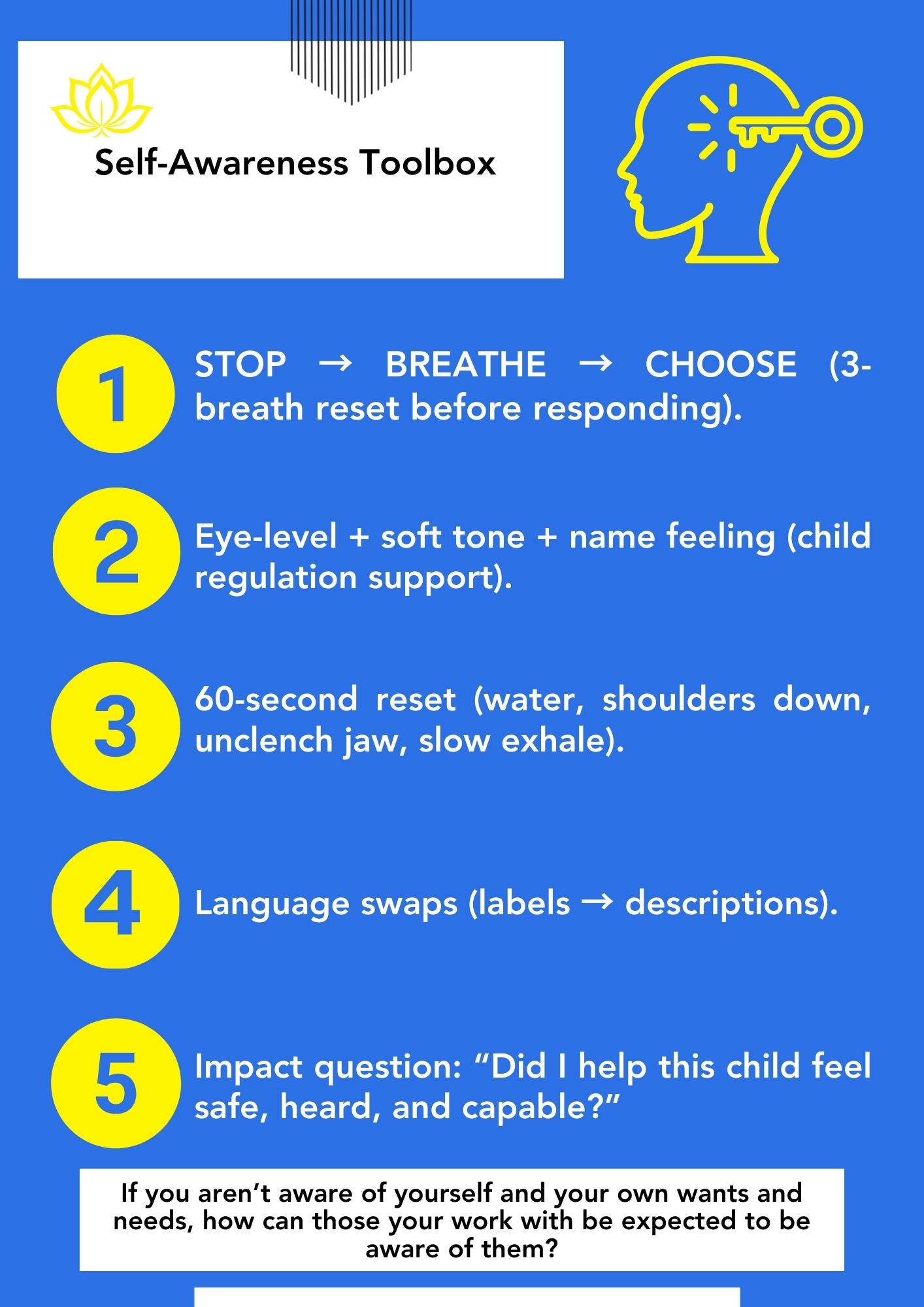
Your Self-Awareness Toolbox
GIST – Good Ideas for Starting Things…
- Notice your emotional triggers: Self-awareness begins with recognising what affects you before trying to change anything.
- What staff should notice and focus on:
- When do I feel stressed, impatient, or overwhelmed?
- Which parts of the day are hardest for me? (transitions, noise, behaviour, time pressure)
- Which children or situations test my patience more than others?
- Simple actions to try:
- Pause and name the feeling (“I’m feeling rushed”).
- Take 3 slow breaths before responding.
- Make a short note after challenging moments.
- Impact: Helps staff move from reacting automatically to responding thoughtfully.
- What staff should notice and focus on:
- Reflect on the impact you have on children: Self-awareness grows when staff understand that how they are affects how children feel, behave and learn.
- What staff should notice and focus on:
- How did my tone or body language affect this child?
- Did I help the child feel calm, heard or safe?
- Would I want to be spoken to in the way I spoke to the child?
- Simple actions to try:
- Get down to children’s eye level.
- Slow your speech and soften your tone.
- Observe children’s reactions to your responses.
- Impact: Builds empathy, improves behaviour support, and strengthens relationships.
- What staff should notice and focus on:
- Ask for and use feedback: We all have blind spots. Gentle feedback helps staff see what they may not
notice themselves.- Ways to start safely:
- Ask a colleague: “What’s one thing I do well and one thing I could improve?”
- Use supervision to talk honestly about challenges.
- Observe a colleague and reflect on differences in approach.
- Simple actions to try:
- Listen without defending.
- Choose one small change to focus on.
- Revisit feedback after a few weeks.
- Impact: Turns awareness into growth and builds a reflective team culture.
- Ways to start safely:
Want to learn more?
- Search for Brené Brown – short clips on YouTube: vulnerability, shame triggers, courage, feedback and empathy (easy to digest in small doses).
- Read The Decision Lab blog for simple explainers on biases and behaviour change (good for “why did I react like that?” moments).
- Listen to The Happiness Lab podcast by Laurie Santos, it’s light science of habits, emotions, and behaviour change.
- Read Atomic Habits by James Clear, tiny changes, remarkable results.